
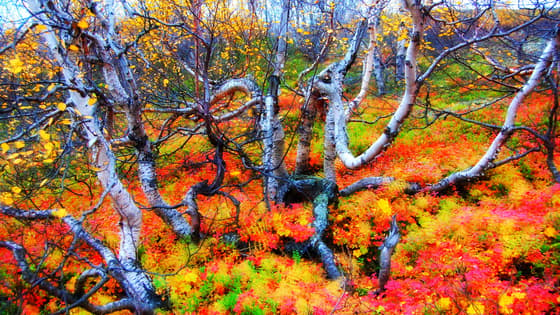
Scandinavian “foliage” is one of the most evocative natural spectacles in Northern Europe, and one of the earliest. It appears between September and early October, when summer gives way to autumn. Forests, mountains, fjords, and lakes transform into a palette of yellow, orange, red, and copper-brown during these weeks. Booking a vacation here in late September is a great idea, as it is the perfect time to discover the Scandinavian nations at a slower pace, with nature hikes, breathtaking views, and small villages immersed in autumnal colors. But when is the best time to admire the autumn colors in Scandinavia? And where? The answer depends on latitude, altitude, and weather conditions: in the North, the colors arrive earlier, while in the southern regions, autumn lingers longer.
When to see autumn colors in Scandinavia?
The Scandinavian autumn color season generally focuses on September and October, but there’s no one-size-fits-all date. In Norway and northern Sweden, the first colors can appear as early as mid-September, while in southern areas, the peak can occur between late September and mid-October.
The most useful rule is simple: the further north you travel, the earlier autumn arrives. Altitude also plays a role: in mountainous areas, lower temperatures accelerate the change of leaves.
In Finland, the phenomenon even has a specific name: ruska , the term used to describe the characteristic autumn colors of Nordic vegetation. In Lapland, the season generally peaks in the second week of September and lasts about ten days, although the exact timing varies depending on the climate. The further south you travel, the later the foliage arrives.
In Norway: red leaves between fjords and mountains
Norway in autumn offers particularly spectacular scenery, combining autumn colors with some of Scandinavia’s most iconic landscapes. The colors of the forests and slopes reflect on the waters of the fjords, while the mountains provide a stunning backdrop. To admire all this, after landing at Oslo Airport (OSL), rent a chauffeured transfer and treat yourself to a stress-free tour of fascinating locations.
Jotunheimen, for example, with its high mountains and lush valleys, is an ideal region for those who want to combine hiking and nature photography. The Westfjords region also offers spectacular views: in autumn, the slopes take on warm hues that contrast with the blue water and rocky peaks. For those who prefer not to stray too far from the capital, the forests of Oslomarka, easily accessible from Oslo, are an interesting option for an autumn walk.
Finally, in Northern Norway, autumn can offer an even more unique combination: during the darkest nights, daytime foliage can be accompanied by the chance to observe the Northern Lights.
Sweden: golden forests on lakes
Sweden is the perfect setting for those who associate autumn colors with vast golden forests reflected in luminous lakes. Among the Scandinavian countries, it is perhaps the richest in forests, bodies of water, and natural parks, easily accessible from all airports, from Stockholm (ARN) to Gothenburg (GOT) to Luleå.
Northern Sweden is particularly evocative: in the areas of Swedish Lapland, the landscape gradually takes on golden and reddish hues, while further south, autumn tends to develop later. To experience the season of colors authentically, the ideal is to follow a hiking trail or choose a car itinerary with stops in parks such as Sarek or Tyrsta, and in small towns. Sweden’s advantage is precisely its variety: you can go from wild forests to lakeside landscapes without giving up the opportunity to visit cities and cultural attractions.
Autumn in Finland is magic
If your goal is to experience autumn colors at their most spectacular, Finland deserves a top spot on the list. Here, autumn is deeply linked to the concept of “ruska,” an explosion of yellow, red, and orange hues that—oddly enough—involves not only the trees, but also shrubs and undergrowth.
Finnish Lapland (with Rovaniemi as its main hub) is one of the most captivating destinations. The rounded hills, called fells, offer ideal vantage points for observing the landscape from above. Destinations worth considering include Pallas-Yllästunturi, Urho Kekkonen, and Oulanka, where hiking and nature allow you to fully immerse yourself in the autumn atmosphere. Koli, in eastern Finland, is also an excellent choice: the hilly landscape and lake views are one of the country’s most famous sights.
Those who don’t want to travel all the way to Lapland can also experience foliage in Helsinki. Not far from Helsinki Airport (HEL), the capital’s city parks, waterfronts, and historic neighborhoods are awash with color, especially between late September and early October, offering an ideal alternative for an urban trip immersed in the colors of autumn.
Scandinavian Foliage: how to admire it the right way
The best way to enjoy Scandinavian foliage depends on the type of experience you’re looking for.
Trekking is probably the most engaging option. Walking in the woods allows you to observe leaves, moss, lakes, and wildlife up close, as well as reach scenic spots that are otherwise difficult to access. In Finland, for example, a ruskaretki is an excursion dedicated to discovering autumn colors. Another option is to organize a road trip. Renting a car allows you to follow scenic routes, stopping at the most beautiful spots, and modifying your route based on the advance of the foliage. This is particularly suitable in Norway, where the connections between mountains, valleys, and fjords offer ever-changing scenery.
For photographers, however, the best time is often early morning or late afternoon, when the softer light enhances warm tones. Furthermore, after rain, wet leaves and lake surfaces can create particularly evocative reflections. It’s worth carrying a spare battery, as low temperatures can reduce battery life.
Scandinavian autumn can be very changeable, so it’s important to dress in layers. A waterproof jacket, suitable hiking shoes, and easily adaptable clothing are essential, especially in the northern regions. In Finland, for example, in September, temperatures can vary significantly between day and night, so it’s advisable to be prepared for both mild days and temperatures close to freezing. Being perfectly prepared allows you to face without worries the activities that will allow you to enjoy up close the change of seasons, the magnificent autumn colours that make these lands magical.
