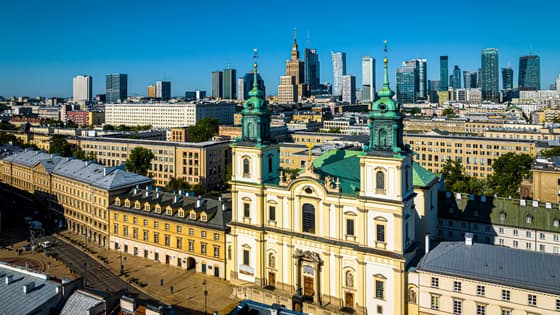
Its inhabitants, who have seen it die and be reborn again and again, never get tired of saying it: “Kocham Warszawę”— which means: I love Warsaw. They write it on the walls of the suburbs, light it on with a thousand lights in the historic quarters, and have artists paint and sculpt it. So why do tourists seem not to love Poland’s capital? Why do they always prefer other holiday destinations? Located on the Vistula River, Warsaw has transformed dramatically over the past century while preserving important reminders of its long and complex past. From the picturesque streets of the Old Town to peaceful royal gardens and modern museums, there are countless things to see and do in Warsaw.
Your way to Warsaw
When you land at Warsaw International Airport (WAW), you notice it immediately: the city is just a stone’s throw from the terminal—only 9 km away! In addition to public transport, the airport is served by numerous private taxi companies, and our own chauffeur-driven vehicles should be your choice. They will quickly and comfortably take you wherever you wish to go—whether to the city center or the surrounding areas. Plus, our drivers—local professionals—can share the information about this capital city’s beauty with you.
Explore Warsaw: the Old Town
Also known as “Paris of the North”, Warsaw is a gem glittering with art, history, modern colors. One of the best places to begin your visit is the Old Town, or Stare Miasto. This historic quarter is famous for its colorful townhouses, cobbled streets, large and charming squares, and historic churches. The heart of the district is Market Square, surrounded by restaurants, cafés, and beautifully reconstructed buildings. It also hosts the Warsaw Mermaid, or Syrenka, one of the city’s best-known symbols.
Walk through the narrow streets toward the Barbican , a historic defensive structure that once formed part of Warsaw’s medieval fortifications. From here, you can continue along the city walls and explore the surrounding streets. Another major attraction is the Royal Castle, located at Castle Square at the entrance to the Old Town. Set in front of the old column monument, Kolumna Zygmunta, the former royal residence contains historic interiors and works of art and is an important part of Warsaw’s heritage.
Walk along the Royal Route
The Royal Route is one of the most enjoyable ways to experience central Warsaw. It connects several important historic landmarks and passes along some of the city’s most elegant streets.
Start around Castle Square and continue along Krakowskie Przedmieście before reaching Nowy Świat. Along the way, you will find churches (St John’s Cathedral, Holy Cross Church, St Anne’s) , monuments, historic buildings, cafés, restaurants, and shops. The Presidential Palace is one of the landmarks along Krakowskie Przedmieście. You can also see the monument to Nicolaus Copernicus, the famous Polish astronomer, in this part of the city.
The Royal Route is particularly pleasant in the evening, when the streets and historic buildings are illuminated.
Discover Warsaw’s history
Warsaw’s history is essential to understanding the city. Several museums provide an opportunity to learn about Poland’s past and the events that shaped modern Warsaw.
The Warsaw Uprising Museum is one of the city’s most important historical attractions. Its exhibitions tell the story of the 1944 Warsaw Uprising through photographs, documents, personal stories, and multimedia displays. Another important institution is the POLIN Museum of the History of Polish Jews, which explores the centuries-long history of Jewish life in Poland.
For art lovers, the Polish National Museum offers extensive collections covering Polish and European art. Visiting these museums can add considerable depth to a Warsaw sightseeing itinerary, especially for travelers interested in European history and culture. Another unmistakable feature of the Warsaw skyline is the Palace of Culture and Science. Built during the post-war period, this enormous building remains one of the city’s most recognizable landmarks.
Panoramic views and green relax
For panoramic views of Warsaw, consider visiting one of the city’s observation points. The observation terrace at St. Anne’s Church provides an excellent perspective over the Old Town and central Warsaw. The contrast between historic churches, reconstructed Old Town buildings, communist-era architecture, and modern skyscrapers is one of the most distinctive features of Warsaw.
For a break from the busy city center, head to Łazienki Park, one of Warsaw’s most beautiful green spaces. The large park combines landscaped gardens, ponds, monuments, palaces, and wooded paths. Its most famous building is the Palace on the Isle, a beautiful neoclassical residence surrounded by water. During warmer months, the park is also associated with outdoor concerts dedicated to Frédéric Chopin, one of Poland’s most famous composers. Also enjoy strolling through the Saxon Gardens or admiring the autumn colors at the Pole Mokotowskie Park.
The Vistula River is an important part of contemporary Warsaw. Its riverside areas have become popular places for walking, cycling, relaxing, and enjoying the city’s outdoor atmosphere. For a different perspective of Warsaw, consider taking a river cruise or exploring the paths along the opposite bank.
Does Warsaw also have a modern side?
Although Warsaw is famous for its history, it is also one of Central Europe’s dynamic modern capitals. The city center is filled with contemporary skyscrapers, cafés, creative spaces, shopping centers, and restaurants.
The area around Śródmieście is particularly interesting for visitors who want to experience modern Warsaw. You can combine sightseeing with coffee shops, contemporary restaurants, galleries, and nightlife. For a more local atmosphere, explore neighborhoods such as Praga, located on the eastern side of the Vistula. Its buildings, street art, independent venues, and alternative cultural scene provide a different perspective on the capital.
Yes … Warsaw is a city worth exploring!
Warsaw is a destination that rewards curiosity. Its reconstructed historic center tells stories, its museums reveal others, while its modern architecture, restaurants, parks, and riverside spaces show how dramatically the city has evolved.
Whether you are interested in Polish history, architecture, culture, food, or simply looking for an affordable European city break, Warsaw offers a diverse range of experiences. Start in the Old Town, follow the Royal Route, spend time in Łazienki Park, or start from the modern quarters and enjoy the river banks… learn about the city’s turbulent history, and enjoy every single part of it.
With its combination of historic landmarks, cultural attractions, green spaces, excellent food, and lively urban atmosphere, Warsaw is a city that can easily fill a two-, three-, or four-day itinerary. Just start planning… !