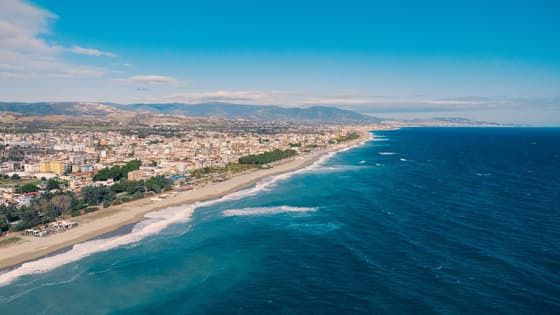
Locri and its beaches have been awarded a “Blue Flag” this summer of 2026, and there’s no better reward for an area of Calabria with such a breathtaking beauty and long, troubled history, often associated with criminal activity. Locri experienced difficult times after the unification of Italy, and banditry persisted in its hinterland for a long time. Only in the 1990s have things changed radically, and society has regained control of its territory, transforming previously frightening locations into wonderful tourist destinations. Locri’s Blue Flag Beaches means that the sea of this municipality (population 11,000) in the province of Reggio Calabria is comparable to exotic Caribbean sites! Come and discover this beauty; it is easily accessible thanks to Reggio Calabria Airport (REG). Alternatively, fly to Lamezia (SUF) and reach Locri with a transfer tailored just for you, that will get there in an hour and a half.
A new Locri
Until 1934 this town was called Gerace Marina, but its roots stretched back millennia to an ancient colony of Greeks arriving from the Locride region. Its ancient name was, in fact, Locri Epizephyrii, and even today this is the name that indicates the ruins located not far from the town; in the 1930s, the municipality decided to revert to this old name, which has remained to this day. The “new Locri” is not only the one that renewed its name, but also the one that managed to find its redemption by abandoning illegality and inaugurating a successful tourist season linked to both sea and mountain.
Beaches of Locri
The beaches of Locri are all beautiful. Ranking them is almost impossible; you should have the opportunity to experience them all! While many tourists prefer the Central Beach, precisely because of its proximity to the town’s center and its wealth of amenities, a beach like Moschetta… behind the Locri Epizephyri archaeological park… offers a unique sensation, as if you’ve stepped back in time, certainly worth discovering. The most romantic, quiet, and wild beaches are Portigliola and Sant’Ilario allo Jonio, bordered by vegetation and offering clear landscapes with fabulous views, especially at dawn. A large golden beach also runs north, up to the close municipality of Siderno.
Precisely because of the unique nature of each beach, all expressing a unique beauty, the Blue Flag covers almost all of them. The Lungomare Zaleuco beach, which extends from the Central Beach to the edge of Siderno beach, is particularly worthy of mention. The reasons for this recognition are highlighted by sustainable development, careful waste separation, good bathing services, accessibility and, in particular, inclusiveness. The new water purification system, which radically changed the quality of the sea and was a concrete commitment carried forward by the entire community, certainly played a significant role.
From the sea to the mountains
Locri isn’t just about the sea. Indeed, for many years, almost no one paid attention to its beaches, as media attention focused only on the wild nature of the Aspromonte, 40 km from the town center. Due to past banditry problems, the news always reported sad events happening in those mountains. But today, “cleaned” of all dangers, they too have become a fascinating tourist destination.
You can easily base yourself at the Blue Flag seaside resort of central Locri and then travel, with organized tours, to the Aspromonte mountains. Guided tours will lead you to discover solitary and unique environments such as Platì, Santa Cristina, Africo Vecchio, Bova… or to discover the magic of the area known as “la Grecànica” (the Greek) with villages that still preserve the ancient Greek language and tradition (Gallicianò, Roghudi, San Lorenzo, Roccaforte del Greco, Condofuri, Melito di Porto Salvo, Palizzi).
Aspromonte is also a protected natural park, home to gems such as the Amendolea waterfalls, the Aposcipo and San Leo waterfalls, the Chalonero waterfalls and Forgiarelle; historic rock formations such as the Valle delle Grandi Pietre and the Pietra Cappa; the “ancient forests” of San Luca; and ghost towns such as Amendolea itself or Precacore, where nature now inhabits the ruins of abandoned medieval houses. Climb up to Polsi, to the Sanctuary of the Madonna della Montagna, for a pilgrimage that will be more than just a prayer.
What to do and see in Locri?
The archaeological site of Locri Epizefiri is the community’s main monument. Although devastated by the mad search for building materials, in the past, what remains today is enough to admire the shape of an ancient city. Many objects found here are kept at the local National Museum.
The ancient city is not far from the modern one. In new Locri you can admire churches such as the cathedral (Romanesque in style but built in the 1930s), the 19th-century Santa Caterina, the charming San Filareto, nestled in an 18th-century farmhouse. The buildings in the historic core all date back to the post-unification period (19th century): among the most beautiful are Palace Teotino-Delrio, Palace Zappia, Palace Scannapieco, and the Town Hall. Heading south, almost to the border with Bovalino, you can admire other ancient remains such as the Roman villa and mosaics of Casignana.
The beauty of spending your holidays in Locri, however, also lies in fully enjoying the seafront promenade. Shops, trattorias, nightlife venues, events… everything revolves around this long street, offering special sunrises and sunsets. What you cannot miss in Locri (as everywhere in Calabria) is food tasting! Finding the time to slowly savor the excellent and vibrant spicy Calabrian cuisine… with one of the most beautiful seas in Italy in front of you… is “the” experience to live!
What should you leave at home?
If you come to Locri, you’ll have to leave behind old prejudices, mistrust, and snobbery! Let yourself be swept away by a place and people who know how to welcome you. And by a sea that knows how to embrace you.
Discovering Locri in Calabria feels like stumbling upon a hidden treasure waiting quietly by the Ionian Sea. You arrive with only a vague idea of what to expect, but the beauty of this remarkable place will quickly surpass all expectations. The town’s peaceful atmosphere, surrounded by gentle hills, ancient ruins, and the endless blue of the Mediterranean, creates a sense of wonder from the very first moment. The remains of the ancient Greek colony reveal stories from thousands of years ago, while the warm smiles of local people shows the living soul of Calabria today. The archaeological area, with its temples and traces of a distant civilization, offers a fascinating connection to the past.
Beyond its historical treasures, Locri charms with its simple beauty. It is a place that does not need to shout to impress; its magic reveals itself gradually.