
There are places in the world that give a false impression. “False islands” for example. These are islands that… aren’t islands, or that once were, or that still are islands even though they don’t seem so. The mind wanders quickly and gets confused, but it’s all much simpler than it seems. These false islands are beautiful and unique places, waiting to be discovered and experienced, perhaps with a wonderful vacation you might book in advance. We will take you to France, Italy, and faraway Peru. Ready to leave? Pack your bags and let’s go!
Islands and islands
Islands, as we know, are many and varied. These portions of land completely surrounded by water can have very different origins, shapes, and characteristics. From small rocky islands to large insular territories inhabited by millions of people… scholars classify them primarily based on their geological origin.
The first large group is that of continental islands. Examples include Greenland, considered the largest island in the world, Madagascar, which broke away from the African continent millions of years ago, and Australia. Another important type is volcanic islands, created by the activity of underwater volcanoes: when magma rises from the ocean floor and accumulates, it can form mountains that emerge from the water. This group includes many islands, such as Hawaii, Iceland, the Indonesian archipelago, and even the European islands of Sicily and the Canary Islands.
Then there are coral islands, created by the accumulation of the skeletons of small marine organisms, and river islands, which form in rivers when sediments transported by water accumulate, creating new land. There are also artificial islands, built by humans to expand cities, create ports, or build new infrastructure. So what do we really mean by “false islands”?
Mont Saint-Michel: an island from alternating tides
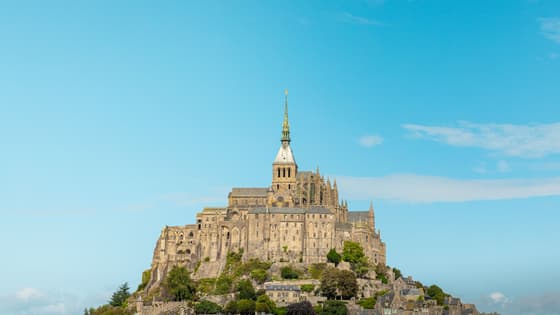
Mont Saint-Michel is now a tiny French municipality (just 34 residents!) located in the heart of the Gulf of Saint-Malo. In ancient times – early Middle Ages – it was an abbey built on the ruins of a Celtic temple dedicated to the god Belenus.
In Celtic times, this area was still forest… today, it is an immense sandy esplanade that battles the sea at alternating times, depending on the tides. It is essentially a rocky islet, normally surrounded by the waves of the Atlantic Ocean. However, for long periods, when the high tides recede, the island remains dry and can therefore be reached on foot via a connecting road. The village on the islet is typically medieval and today almost entirely frequented by tourists.
Mont Saint-Michel attracts curious visitors from all over the world, and many tempt fate by camping right at the foot of this “island-non island”. This is a risky mistake, as there are many cases where the tide, suddenly rising, has swept away campers. After all, the tides, along with the treasures of the ancient abbey, are the village’s main “monuments” and it is natural that tourists want to experience them to the fullest. We always recommend hiring a guide and listening to their advice, without going alone. Mont Saint-Michel can be reached by landing at Nantes Airport (NTE) and continuing via public transportation or chauffeured transfers. Some people land at Paris De Gaulle (CDG) and then take national flights to Nantes.
The former Italian island of Argentario
In Tuscany, along the Grosseto coast, the mighty Mount Argentario looms large. Reaching it is incredibly easy, with two roads connecting it to the beach at Orbetello… yet this place was an island for many centuries!
Given its proximity to the mainland, however, and the narrow strait that separated the island from the coast, the constant accumulation of sandbanks and alluvial debris has formed two strips of land, effectively transforming it today into “just another” coastal promontory. The two roads built on these strips (Giannella way and Feniglia way) encourage the comings and goings of tourists to the villages that make up the Argentario Multiple Municipality (population 11,000). Once there, you should definitely visit Porto Santo Stefano, to the north, and Porto Ercole, located to the south. These are the two most important towns, and Porto Ercole in particular is the place where the great 17th-century painter Caravaggio died. Worth visiting are the Bastion Santa Barbara, Fort Filippo, Fort Stella, and the Orbetello lagoon with its windmills.
To reach Argentario, you can fly into either Florence Airport (FLR) or Rome Fiumicino Airport (FCO), which are exactly equidistant, approximately 160 km from the place. Both airports offer easy public transport (trains, buses) and private transfers.
Do the Floating Islands of Lake Titicaca really exist?
Peru is home to one of the largest lakes in the world: Lake Titicaca. The descendants of some Indio tribes still live on the islands that dot this enormous “inland sea”… except these islands, in reality, don not exist!
Or rather… they exist because human skill created them! The Islas Flotantes (Floating Islands) are, in fact, a gigantic tangle of branches of Totora (Schoenoplectus californicus), an aquatic plant that grows above and below the surface, forming vast expanses of reeds, both along the shores and in the shallow areas of the lake. Thanks to its long, strong, and lightweight stems, it is suitable for many purposes, and for centuries the Uros tribe has built their “floating houses” with it. By intertwining stems and roots, they form compact and sturdy artificial islands that can support the weight of their huts, shops, and even the boats they use for fishing. Beyond its cultural value, the totora plays an important role in the Titicaca environment. Its roots help stabilize the lakebed and provide shelter for numerous species of fish and aquatic birds. The plant also helps maintain the ecosystem’s balance by filtering certain substances from the water.
In order to admire these wonders, though, the route is a bit more complex for the average tourist. Brave adventure lovers face hours – by car or bus – through the jungle, but if you’re not one of them, you might prefer to land at the convenient, small Inca Manco Capàc Airport (serving Puno, the lake’s main town). This airport is accessible via connecting flights from Lima or Cusco (CUZ) airports.
