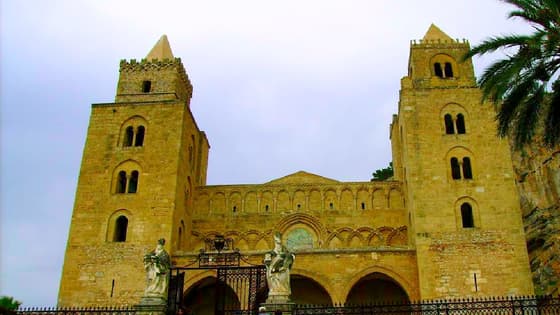
Cefalù is not really Arab … it has strong Greek-Byzantine roots. Its very name derives from the Greek word Kefalà (head, cape), referring to the imposing promontory that dominates it. Yet everything in this seaside town in the district of Palermo recalls the Arab and Islamic world: the urban plan of the historic quarters, the narrow streets that intertwine like a labyrinth, the pointed windows of churches and palaces. Even the austere cathedral, if it weren’t for its two towers, would look like a mosque! Welcome to one of Sicily’s most fascinating places, harmoniously combining the charm of a medieval village, the beauty of its beaches, and an extraordinary historical and artistic heritage.
How will you get to Cefalù?
Getting to Cefalù is easy: land at Palermo Falcone e Borsellino Airport (PMO) and from there, with one of our conveniently designed, chauffeured transfers, you can reach your destination in an hour and twenty minutes on the highway. If your flight arrives at Trapani Birgi Airport (TPS), where low-cost and seasonal charter flights often land, the transfer will last two hours. The chauffeur-driven vehicle can also remain at your disposal, on an hourly basis, to accompany you on a discovery tour of Cefalù and its surroundings. This way, your holiday will be completely relaxing in one of the most beautiful corners of Sicily.
The heart of Cefalù
Cefalù’s origins date back to ancient times. The city was already inhabited in prehistoric ages and subsequently experienced the influence of the Greeks, Romans and Byzantines. However, the period that most marked its development was the Arab-Norman. In the 12th century, King Roger II decided to build the famous Cathedral , which would become the symbol of the city. According to legend, the king built the cathedral as a thanksgiving after surviving a violent storm at sea. Even today, the cathedral dominates the town center with its imposing towers and represents one of the most important examples of Arab-Norman architecture in Sicily.
The interior of the cathedral houses one of the island’s most precious artistic treasures: the magnificent mosaic depicting Christ Pantocrator, made with gold and colored tiles according to the tradition of previous cultures: the Byzantine artistic style and the Arab techniques. The mosaic, like the entire church, is a UNESCO World Heritage Site.
At the foot of the cathedral lies the heart of the town, the historic quarter, which has remained quite intact since the Middle Ages. Narrow streets, small squares, stairways, arches… everything creates a mosaic of stone adorned with colorful flowers on balconies and at street corners. A hidden gem of the historic center is the Lavatoio, an ancient medieval public structure consisting of basins and fountains, once used for washing clothes and today purely for decoration. The fountain is fed by a natural stream that flows from the surrounding hills down into the sea, a few meters away. The historic center finally opens onto the waterfront, always bustling with restaurants, cafés, gelaterias, and clubs where you can spend pleasant evenings admiring the sunset over the Tyrrhenian Sea.
Outdoor living in and around the city
Alongside its historical heritage, Cefalù also offers a natural environment of great beauty. Tourists choose it for its beach, which isn’t particularly large but is romantically nestled among the houses of the historic quarter, facing clear, shallow waters—ideal for families with children.
But if you enjoy sports, Cefalù offers many opportunities: not only swimming, but also diving, canoeing, paddleboarding, and windsurfing. And for those who prefer land to sea, there’s nothing better than a trek to the rocky hill. The famous Rocca di Cefalù, an imposing limestone promontory approximately 270 meters high overlooking the city, can be reached via challenging trails. A hike for true athletes, it offers a unique panorama and… a surprise: the remains of the Temple of Diana, an ancient sanctuary dating back to centuries before Greek colonization, and those of the medieval castle.
The surroundings of Cefalù are also worth exploring. The surrounding area offers stunning natural landscapes, with hills, forests, and small villages steeped in history. Nearby is the Madonie Regional Park, one of Sicily’s most important natural areas, ideal for hiking, trekking, and outdoor activities. This park is home to numerous plant and animal species, as well as characteristic mountain villages that preserve ancient artisanal and gastronomic traditions.
Palermo is not so far away
Palermo is the vibrant capital of Sicily and one of Italy’s most fascinating cities is not so far away from Cefalù; you can easily plan a trip to visit it.
Famous for its rich history, stunning architecture, and lively atmosphere, over the centuries Palermo has been influenced by many civilizations. These cultural influences are reflected in its beautiful churches, palaces, and bustling markets. Visitors often admire landmarks such as the Palermo Cathedral, the Norman Palace, and the Teatro Massimo, one of the largest opera houses in Europe. The city is also renowned for its delicious Sicilian cuisine, featuring dishes like arancini, cannoli, and pasta with sardines. Colorful street markets such as Ballarò and Vucciria offer a unique local experience.
Surrounded by mountains and the Mediterranean Sea, Palermo combines natural beauty with historical charm, making it a popular destination for travelers from around the world.
Tastings and Celebrations
Gastronomy is another key element of Cefalù’s identity. The town’s restaurants and trattorias offer numerous traditional Sicilian dishes, prepared with fresh, local ingredients. Among the most popular specialties are pasta with sardines, swordfish rolls, fresh tuna, sardines a beccafico, and numerous recipes featuring freshly caught fish. Of course, there are also typical Sicilian desserts, such as ricotta-filled cannoli, cassata, granita, and brioche “col tuppo”, perfect for a break on hot summer days.
Throughout the year, Cefalù hosts numerous cultural and religious events involving residents and visitors. Patron saint festivals, traditional processions, summer concerts, and artistic events help keep local traditions alive and enhance the city’s cultural heritage. During the summer, the squares of the historic center become gathering places for musical performances, theatrical performances, and events dedicated to Sicilian crafts.
A holiday in Sicily’s jewel box
Cefalù is small but incredibly rich, like a splendid, refined jewel box that proudly preserves history, culture, nature, and flavors. Here, tourism is certainly the main economic driver, but it is never excessive and never disrupts the town’s natural balance. Cefalù retains its authentic character, the beauty of its sea, the grandeur of the Cathedral, the charm of the historic center, and the warm hospitality of its inhabitants. Visiting it means enjoying an experience rich in emotion, discovering a place where the past continues to dialogue with the present and where every corner offers unforgettable images.