
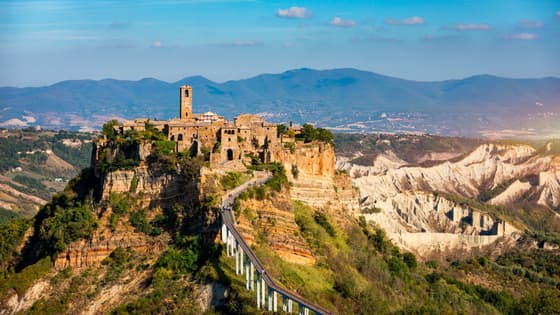
Civita di Bagnoregio is one of the most evocative places in central Italy. It is located in Region Lazio, in the heart of the Tuscia district, near Viterbo, and dominates the valley below from a high spur of tuff rock… the reason for both its beauty and its misfortune. The spectacular location, combined with its unique geological and cultural history, has earned the village the nickname “the dying town”. And it was indeed abandoned by the population following several landslides and earthquakes from the 18th century on. The real fact is, Civita never collapsed and is still there… isolated and beautiful… proud of its historical heritage, the beauty of its landscape, and the growing interest of visitors from around the world. Its tourist fame increased in the early 2000s thanks to the Brazilian soap opera “Terra Nostra 2” , which was partly set here.
Structure of an ancient hamlet
The village of Civita is connected to the town of Bagnoregio (to which it belongs as a hamlet) by a long pedestrian bridge, offering one of the most characteristic views in Lazio. The bridge is the only direct access to the village and makes the arrival particularly evocative: as you walk towards the village, the stone and tuff houses seem to emerge from the rock, silent and discreet guardians of a landscape shaped by the action of water and wind.
Civita’s origins are very ancient. The area was inhabited by the Etruscans, who exploited the strategic position of the rocky spur. The village later came under Roman control and, in the Middle Ages, underwent significant development. Traces of the different eras are still visible in the architecture and urban structure. The narrow streets, small squares, arches, and tuff buildings retain the atmosphere of an ancient medieval town. The heart of Civita is Piazza San Donato, dominated by the church of the same name. The simple yet elegant square is the village’s main public space and an ideal spot for observing the architectural features of the surrounding homes.
Walking through the village streets, you’ll encounter ancient houses, artisan workshops, small cafes, and panoramic views of the valley. One of the most fascinating aspects of Civita is the opportunity to explore it at your own pace, letting yourself be guided by its quiet atmosphere and the distinctive light that changes throughout the day. Between the old town and the town of Bagnoregio, there are several interesting monuments to admire.
What to see on an itinerary in Civita di Bagnoregio?
The entire village is a jewel, worthy of a unique monument. A short itinerary through the town takes little time, allowing you to admire places such as the Church of St Donato in the main square, the nearby Palace Alemanni—home to the Geological and Landslide Museum —the Bishop’s Palace, a 16th-century mill, the remains of the birthplace of Saint Bonaventure, and the Porta di Santa Maria. The views from Civita are also a beautiful monument no one should miss; the gaze extends across the valley, dominated by the so-called “calanchi” – clay hills carved by rain and wind into spectacular lunar shapes. Imagine a sunset over this landscape, seen from above…!
Itinerary from Civita to the surrounding area
The surroundings of Civita offer numerous opportunities to complete your visit. First and foremost, Bagnoregio, the town where the route to Civita begins, deserves attention. Here you can find historic buildings, squares, and testimonies linked to local tradition. The churches, in particular, are the tourist gems of this small town, all of which trace their origins back to the life of the local saint, Bonaventure, who was also an important medieval philosopher and scholar.
A short distance away is Montefiascone, famous for its panoramic location overlooking Lake Bolsena and for the production of the “Est! Est!! Est!!!” wine. The village boasts interesting monuments, including the Rocca dei Papi and the church of St Flaviano. Continuing toward the lake, you reach Bolsena, a town overlooking the shores of Europe’s largest volcanic lake… a natural setting ideal for walks, excursions, and relaxation… while the historic center preserves important medieval remains.
Another interesting place is undoubtedly Orvieto, in nearby Region Umbria, easily reached from Civita. Also built on a spectacular tuff cliff, Orvieto shares many similarities with Civita, but is significantly larger in size and has a much larger monumental heritage. Its symbol is the magnificent Duomo, considered one of the masterpieces of Italian Gothic architecture. The streets of the historic center, the medieval buildings and the numerous underground rooms dug into the tuff are also particularly evocative.
Don’t forget that Rome is also a close destination, about a two-hour drive away. And if you want to admire the beauty of Umbria, from Perugia to Foligno to Terni, the distance is even shorter: you will get there in less than two hours, by car.
Getting to and around Civita di Bagnoregio and where to stay
The closest airport to Civita di Bagnoregio is Perugia Umbria (PEG), although most tourists land at the larger and more international Rome Fiumicino Airport (FCO) which lies 148 km away. Both airports are well-served, especially by private chauffeured transportation, allowing for comfortable, stress-free transfers tailored to each client.
With Bagnoregio as a base, you can easily get around on foot or by local buses, which are almost always punctual and comfortable. If you want to fully experience the beauty of Civita, we recommend booking a room in a B&B or, even better, in a tourist farmhouse in the valley, with the opportunity to also taste traditional food and wine specialties.
Come and experience your fairytale!
Visiting Civita di Bagnoregio means not only discovering an extraordinary village, but also experiencing a region rich in history, nature, and traditions. From ancient Etruscan settlements to medieval villages, volcanic lakes, and landscapes shaped by erosion, Tuscia offers a diverse heritage. Civita, suspended between sky and valley, represents perhaps the most spectacular synthesis of this landscape.
Its beauty stems from the encounter between the fragility of nature and humankind’s ability to build and preserve. For this very reason, Civita di Bagnoregio is not just a tourist destination, but a fairytale place that invites reflection on the passage of time, the transformation of the landscape, and the importance of protecting cultural heritage for future generations.
