
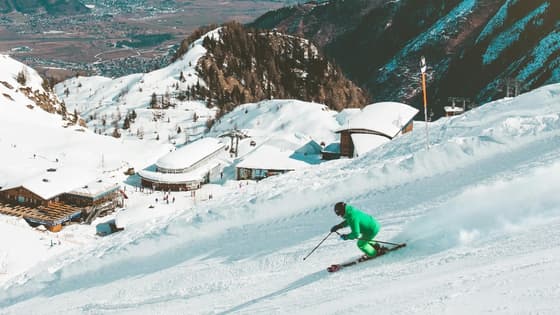
There’s a place in Europe where skiing isn’t just a sport or a Sunday pastime… but a risk that pushes humanity to its limits. This place is located in France, in the Tarentaise Valley of Savoie region, and it’s called Courchevel. It is not just a ski resort, but a facility that boasts, among the over 600 slopes making up its sport network, the steepest descent in all of Europe! Coming to challenge it is the dream of every enthusiast, but succeeding is the privilege of very few true professionals. Because the Grand Couloir… is unforgiving!
The Courchevel Black Slope
The Courchevel Grand Couloir is a black ski slope. But don’t worry, there’s nothing macabre or terrifying about it… it’s just a designation that distinguishes the most difficult slopes from the “normal” ones. The ski tracks are divided into:
• Green – for beginners and families
• Blue – for everyone, with moderate gradients
• Red – of medium difficulty, for athletic or well-trained skiers
• Black – professional, only for expert skiers
But of all the black slopes in Europe, the Grand Couloir is the “blackest”. It is the steepest on the continent, with a maximum gradient of 80% and an average gradient of 55%.
Characteristics of the Grand Couloir in Courchevel
The black slope of the Grand Couloir (which means “the great corridor”) starts without too much trouble: the first section has a manageable gradient, although it is very narrow and exposed. The descent is on a track just 2 meters wide with steep slopes on the sides, and as you progress, the “problems” increase.
The gradient goes up to 35%, then goes to 80%, and then drops to 75%, and you ski among moguls and pinnacles, as spectacular as they are dangerous. The final section features gradients between 60 and 65% and becomes very gentle until it joins up with a medium-difficulty track.
The unique feature of the Grand Couloir is that it isn’t groomed and leveled by snowcat machines. Therefore, during nighttime snowfalls, the landscape suddenly changes and sections that seemed complex yesterday become downright impossible! You can find areas of soft, very deep snow as well as areas of icy snow. This is why it’s essential to be experienced and well-trained, but above all, to always be informed about the weather forecast and snow conditions.
How to get to Courchevel and what to do besides skiing
Courchevel is served by a regional airport, Chambery, located about 63 km away, but tourists mostly use the nearby airports of Geneva (GVA) in Switzerland or Turin Airport (TRN) in Italy. Both are less than 90 km away from the ski resort and are well connected.
If you are looking for more than just skiing, Courchevel offers numerous tourist attractions. Starting with visits to the villages that collectively are part of the ski resort: Saint-Bon-Tarentaise (the main municipality), Le Praz, La Tania, Courchevel Village, Moriond, and Courchevel 1850. The most important of these are Courchevel 1850, which is home to all the hotels, and Saint-Bon-Tarentaise, the largest village. The beauty of the mountain landscapes is the resort’s main attraction, but the surrounding Savoy region offers much more to see and do.
In about a three-hour drive, you can easily reach the medieval town of Briançon, with its UNESCO World Heritage stone fortifications. In just two hours and 40 minutes drive, you can visit the splendid city of Lyon, while just a stone’s throw away (one hour and 45 minutes) are Annecy, Grenoble, and Valence. Crossing the border, you can take a day trip to Geneva, just two hours away, while Turin and Aosta are further away (but not unreachable!), about four hours away.
The challenge and the beauty
Choosing Courchevel for your winter vacation means treating yourself to both the adrenaline rush of extreme sporting challenges and the beauty of relaxing in nature and culture, at the heart of the routes connecting three nations with an “Alpine heart.”
