You don’t have to be a believer to appreciate the atmosphere of Easter. And you don’t have to be Catholic to capture the emotion of the celebrations associated with this holiday, especially in those countries where certain moments become intensely popular. Italy is at its best during the Easter period. The south, in particular, hosts the most colorful and engaging celebrations. But, following the Holy Week calendar, we’ll take you to discover three specific rites that range from Florence to the major islands, combining spirituality and artistic beauty.
Maundy Thursday: “Le Vare” in Caltanissetta
Landing at Catania Airport (CTA) or Palermo Airport (PMO), the distance remains the same. With dedicated transfers, you can easily reach the heart of Sicily, the district capital Caltanissetta, which few people truly know. And what better time to discover it than during Holy Week, with all its rituals?
Holy Week in Caltanissetta is famous for its reminiscent of the Spanish celebrations in Seville, and in particular the evening of Maundy Thursday is the time for the so-called Vare (VIDEO HERE). The custom of carrying these groups of statues in procession dates back to the 18th century: the statues were made of papier-mâché and wood and put on “catafalques” carried on shoulders. Only at the end of the 19th century, however, did they take on their current appearance thanks to the interest of highly skilled artists, a testament to the wealth of Caltanissetta at the time. Each vara carries life-size figures and depicts scenes from the Passion of Christ, some of which are inspired by famous Renaissance paintings. Each Vara refers to a trade guild that, with the help of musical bands, accompanies the scenes until late at night (2 or 3 am), separating only to meet again the next day.
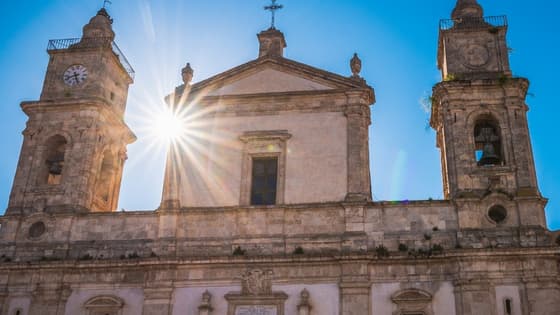
If you are staying in Caltanissetta, stop to admire the Baroque historic quarter: the Cathedral of Virgin Mary of la Nova, the Church of St Sebastian, the Abbey of the Holy Spirit, the churches of St Agata, Our Lady of the Angels, and Holy Cross. Don’t miss the city palaces, the ruins of Pietrarossa Castle, and Villa Amedeo (one of the city’s three public parks). A monument to modernity is the towering antenna of the radio transmitter (286 m high), now unused but still towering over the city.
Good Friday: the “Calvary” of Iglesias
To reach Iglesias, you will have to land at Cagliari Airport (CAG) and drive approximately 46 km to this splendid town on the western coast of Sardinia. You shall be greeted by a perfectly preserved historic area, rich in Gothic, Romanesque, and Neoclassical architectures. Your tour itinerary will include, among its most beautiful stops: the Cathedral of St Chiara, the Medieval City Walls, Salvaterra Castle, the Old Town Hall, Palazzina Bellavista, and surrounding sites such as Porto Flavia and the Proto-Nuragic ruins.
But if you find yourself in Iglesias on Good Friday, also follow the Procession of the Mount. It begins in the morning, ascending towards a “Calvary Hill” represented by the Church of St Michael, where the statue of the Dead Christ is placed and worshipped throughout the day. In the afternoon, to bring the statue back to the city center, the melancholic “Descenzo” procession begins—a true sacred representation of a “Sardinian” funeral, but applied to the body of Jesus. The city’s religious associations accompany the procession in an emotional and at times very moving atmosphere (VIDEO HERE ).
Easter Sunday: the “Explosion” in Florence
What about Florence? It needs no introduction! An Italian tourist destination par excellence, it offers historic routes rich in artistic and architectural beauty. On Easter Sunday, however, the center of Florence comes alive also with another emotion: the Explosion of the Cart! If you want to admire it, your nearest reference airport will be the one serving the city, Florence (FLR).
Florence’s Easter tradition dates back to the early Crusades and commemorates the celebration in honor of the liberation of Jerusalem through the lighting of a purifying fire. Today, the ceremony is linked to Easter Sunday (VIDEO HERE ), thanks to a change that occurred around the 18th century: since the cart was inevitably damaged every year by fire, in 1765 it was decided to build a sturdy and long-lasting one, the so-called “Brindellone”. A three-stores high (10 meters) machine, this cart is no longer destroyed but decorated with hundreds of torches and fireworks. Light and noise, but no longer devastating fires, ensure the spectacle is guaranteed to last forever.
The cart is “lit” by a dove-shaped rocket tied to a rope that, after igniting the sparks, is supposed to return to the bishop’s hand that launched it. If the rocket comes back immediately, the year will be a lucky one. If it jams or burns out, it means bad luck! Where in the world can you find such an extravagant emotion that unites the sacred and the profane in the same gesture? You really can’t miss it!