
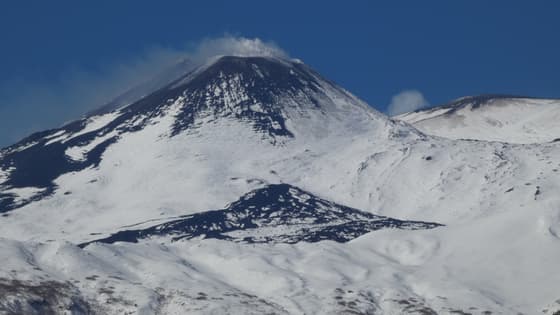
Skiing is already a thrill, and doing it on challenging mountains heightens the adrenaline. Have you ever tried skiing on a volcano? Not just on an extinct volcano, which is still a challenging terrain, but also on fully active volcanoes that can offer thrilling spectacles at any moment. Only a few brave souls take on these challenges, unless they live at the foot of these incredible mountains and are therefore accustomed to their surroundings. We’ll take you on a tour of the ski resorts on some of the world’s most famous volcanoes.
Etna: queen of Sicily
In Sicily, you can ski both on the mountains of Palermo and Catania, but it’s undoubtedly Mount Etna that offers the most thrills. A mountain that here is seen as feminine, despite being a mighty and active volcano; a reality that welcomes tourists in every season. The ski resorts located on the northern and southern flanks of this great volcano (3,400 m) welcome winter sports enthusiasts from all over Southern Italy every year. Sliding down snow-covered slopes while Sicily’s Ionian coast opens up before you and the summit craters rumble behind your back, is a deeply exciting experience.
It’s not uncommon to witness spectacular eruptions while skiing on Mount Etna, with towering columns of steam and ash and the dark lines of boiling lava melting the ice.
But don’t worry. Etna’s summit craters are far from the ski slopes, located at Piano Provenzana and Rifugio Sapienza, beyond the natural barrier formed by the Bove valley. Thanks to this valley, the facilities and villages are safe, well protected from any eruption. Only rare lateral eruptions can disrupt Etna’s ski scene… but in any case, these occur after numerous warning signals. No one has ever been in danger here, although a few daredevils have tried to ski just meters from the lava flow (VIDEO HERE)… These are escapades you absolutely must not imitate! Etna is easily accessible from Catania Airport (CTA).
Skiing on Chile’s volcanoes
Chile is home to dozens of volcanoes, including active, dormant, and extinct. This long South American country enjoys long, glacial winters, which however are in July and August — given its location deep in the Southern Hemisphere. Now imagine the thrill of launching yourself on skis or a snowboard into a volcano in the middle of August! A must-try, right?
You can enjoy the experience at Chile’s most famous ski resorts, those near the active volcanoes of Chillán and Llaima, or at Mount Lonquimay. The latter is a dormant volcano that rarely erupts, allowing you to take risks even getting close to the crater. Mount Puyehue is also a dormant volcano. The last eruption was in 2011, and when it’s not active, its crater fills with snow and ice, allowing for adventurous descents into the depths of this immense vent! Experience the thrills of skiing down the steep slopes of the Villarica volcano.
Breathtaking landscapes and a guaranteed adrenaline rush are what make skiing on Chilean volcanoes a highly sought-after adventure for professionals. To reach these locations, often hidden in the country’s mountainous interior, use the main airports of Santiago (SCL) in the north and Puerto Montt (PMC) in the south.
Mount Yotei and Mount Asahidake in Japan
The home of Japanese winter sports is the island of Hokkaido, in the far north of the archipelago. Landing at Sapporo Shin Chitose Airport (CTS) offers all the ideal transfer options for conveniently reaching the ski resorts of the local volcanoes.
Mount Yotei is a large, extinct volcano that allows skiing inside the crater. It can be reached from the town of Makkari, climbing up to 1,100 meters along the trails of the park of the same name. There are no real ski facilities on this mountain; in fact, it is a challenging “black” off-piste area suitable for only a few experts. Skiing for all levels, however, is available at the nearby Niseko facilities located just opposite Yotei. Mount Asahidake is an active volcano and the highest peak in Hokkaido (almost 3,000 meters). Two ski resorts serve winter sports on its slopes: one is located in the valley, near the town of the same name; the second is at 1,600 meters, where the cable cars stop.
Both mountains have very steep slopes, which plunge suddenly into the woods, thus increasing the danger of the descents. But with that comes the thrill of those who love to challenge their limits.
