
There is no better season than autumn to set out and discover ever-new historical and artistic itineraries in Italy. We suggest traveling one of these routes in Tuscany, specifically between the cities of Lucca and Siena. It is a short distance—144 km via the A11 motorway or 188 km along the State Road SS67 —taking about two hours and allowing you to visit various fascinating towns, each with its own medieval charm or bustling commercial energy. Both the starting point and the destination offer unique, breathtaking beauty. To reach Lucca and Siena, the primary airport is Florence (FLR), though the regional Pisa (PSA) airport also handles tourist flights. Rome Fiumicino Airport (FCO) is another excellent option, particularly for intercontinental flights.
Lucca: let’s get started!
Lucca is renowned for its central historic quarter. The finest art itineraries of this first step of your Tuscan tour unfold around this beautifully preserved “jewel box” of a city; one of the most delightful experiences is strolling along the ancient Medieval Walls, shaded by trees that still allow for stunning views of the city. You can also travel this route by bicycle, if you wish.
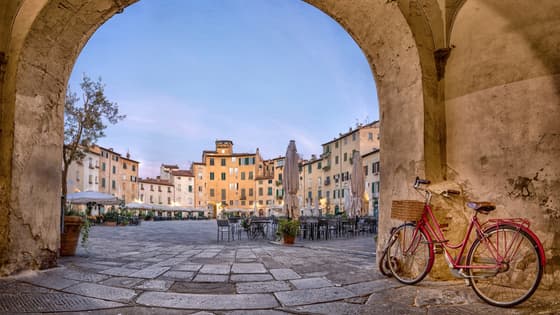
In the heart of Lucca lies Anfiteatro square; it features a classic medieval layout with the elliptical shape often found in Tuscan towns. Built upon the ruins of an ancient Roman amphitheater, it serves as the hub from which various streets and monuments radiate, such as the Cathedral of St Martino—a significant example of Romanesque architecture that houses artworks of great value. …the city’s symbol—the Guinigi Tower—famous for the holm oaks growing at its summit (it is open to visitors and offers breathtaking views from the top); and numerous noble palaces such as Palazzo Bartolomei, Brancoli Pantera, Buonvisi, Gigli, and the Ducale Palace. Napoleone square and the Basilica of St Michele in Foro are certainly worth a visit.
Lucca is an ideal city to explore at a leisurely pace, allowing yourself to be captivated by its history, elegant atmosphere, and charming corners. There is a vast array of churches and palaces, as well as shops and restaurants—some of which overlook splendid gardens. It is the perfect starting point for a special journey.
Pistoia
The second stop on the journey, following the A11 motorway, is Pistoia. Famous for its stunning polychrome churches—such as the Cathedral of St Zeno (10th century) and its Baptistery, both dominated by an elaborately detailed bell tower, as well as Pieve St Andrea, St Maria Cavaliera, and the spectacular St Giovanni Fuorcivitas—the city also boasts remarkable secular architecture.
As the birthplace of composer Giacomo Puccini, the city offers an itinerary dedicated to him, including his beautiful family villa. Villas are another highlight of this city—a sort of “shy Florence” that doesn’t show off but is well worth a visit! Be sure to explore the “Ipogeo”, that is underground Pistoia, so to discover an ancient, hidden world.
Prato
Today, Prato is famous in Italy for its fabrics and its Chinese population! Thanks to the textile industries that attracted many workers from Asia, it is fair to say that one in three residents of Prato is of Chinese origin. By stopping here, you will certainly admire a historic center rich in artistic treasures, adorned with fine marble—you must take a photo of Donatello’s pulpit!—and elegant churches. Highlights include the Palace Pretorio and the Imperial Castle, as well as ancient Roman bridges and the vast Mercatale square. In Prato, you will experience a delightful blend of traditional Italian medieval art and a modern Italian-Chinese heritage!
What will you see in Sesto Fiorentino?
This small town boasts a breathtaking landscape dominated by the snow-capped peaks of Mount Morello. Its territory, crossed by four rivers, is dotted with medieval architectural gems of exceptional quality. Among the many highlights, you will certainly want to admire the parish churches of St Martino and St Andrea, the St Domenico Monastery, and St Bartolomeo a Carmignanello. Surrounding the town center, you can see medieval and 19th-century villas, as well as archaeological sites containing Etruscan tombs.
Poggibonsi and Colle Val d’Elsa
The final two stops on the journey before reaching the destination are Poggibonsi and Colle Val d’Elsa. Poggibonsi is a charming town that seems to have remained unchanged since the 10th century! Cobblestone lanes, narrow alleys, small squares, and bell towers fan out around the town center’s medieval churches, transporting you back in time.
Similar—though perhaps even more evocative—is the village of Colle Val d’Elsa, formed by the unification of several smaller villages. Beyond the historic heart of the village, key attractions include the Crystal Museum and the Diborrato Waterfall (located about 4 km from the center). Colle Val d’Elsa is part of the Via Francigena pilgrimage route.
Welcome to Siena
Siena is one of the world’s most famous cities, renowned for its historic center that unfolds around Del Campo square —the setting for the famous Palio !
This vast, shell-shaped square, considered one of the most beautiful in Italy, is home to the Palazzo Pubblico (the historic seat of city government) and the distinctive Tower Del Mangia, which offers a magnificent panoramic view of the city. Another unmissable stop is the Siena Cathedral (Duomo), an extraordinary example of Gothic architecture. Its interior is richly decorated with marble, sculptures, and fine art works. The Baptistery and the Museum dell’Opera del Duomo are also located right next to the cathedral. Strolling through the city center, you can discover Siena’s seventeen contrade (quarters), each with its own unique symbols and colors. These quarters compete against one another twice a year in the Palio—a traditional horse race that draws both locals and tourists into a spectacle that is at once beautiful and intense.
While in Siena, it is certainly worth tasting some typical Tuscan dishes, such as pici pasta and ribollita soup, as well as Sienese sweets like panforte and ricciarelli.
Passing through Empoli
To travel from Lucca to Siena, you can also take an alternative route; while it features fewer stops and monuments, it does include a pass through the city of Empoli along the SS 67 state highway.
Empoli is a city located in the Arno River valley. It is a medium-sized town known for its history, traditions, and vibrant economic activity. Its historic center preserves significant buildings and squares, including Farinata degli Uberti square, home to the Collegiate Church of Sant’Andrea—one of the city’s main landmarks. Like Venice, Empoli is famous for glassmaking, a craft and industrial activity that has played a key role in the city’s development.
The city also offers various green spaces and cultural sites, such as the Glass Museum and the Museum of the Collegiate Church of Sant’Andrea. Thanks to its location, Empoli serves as a convenient stopover for anyone traveling from Florence to Siena—or, as you are doing today, from Lucca to Siena!
