When you visit Gabriel García Márquez’ Colombia, remember the echo of his words. This writer—a native of Aracataca and a passionate resident of Cartagena de Indias—penned lines such as: “Never stop smiling, not even when you are sad, because you never know who might fall in love with your smile” … “I love you not for who you are, but for who I am when I am with you” … “Don’t cry because it’s over; smile because it happened”. Of his hometown, he said: “You’ll see, everything is different in Cartagena. This solitude without sadness, this ceaseless ocean, this immense feeling of having arrived”. Following these words—which are pure poetry—everything around you will seem beautiful. So, treat yourself to these emotions with an itinerary dedicated to Márquez and his very own Colombia.
Traveling on three airports
Distances in Colombia are great. In order to follow this itinerary, you will need to rely on air travel, alongside bus journeys or private car services with drivers – like the one we offer.
You will likely land at Bogotá El Dorado Airport (BOG); from there, you will need to take domestic flights to airports in northern Colombia—specifically Barranquilla (BAQ) or Cartagena (CTG). We recommend selecting specific stops along the route, because if you want to cover the entire itinerary it would require several weeks of travel.
The Barranquilla airport serves the locations of Garcia Márquez’s childhood, while the Cartagena airport allows you to explore the places associated with his mature years. Bogotá also holds traces of Márquez’s life, as he completed part of his studies there. Here, we describe in detail the stops on the journey “around this extraordinary writer’s world”.
Aracataca: the beginning
Gabriel José de la Concordia García Márquez (1927–2014) was born into a huge family (sixteen children!). His parents lived in Aracataca, a town in the Magdalena province, amidst a landscape of fields and rivers where “magic” quietly mingled with Catholic traditions. Gabriel’s own mother was a clairvoyant!
Aracataca was founded in the 19th century and grew thanks to river trade and its proximity to the Caribbean port of Barranquilla, just over two hours away. Today, a one-hour drive from Aracataca takes you to a beautiful nature reserve—the Santuario de Flora y Fauna Ciénaga Grande de Santa Marta—situated on a vast lagoon teeming with flora and fauna. These landscapes played a significant role in many of Garcia Márquez’s writings, particularly in his celebrated novel << One Hundred Years of Solitude >>. Strolling through the streets, one encounters colonial buildings, tropical gardens, and sites linked to the writer’s life. Key landmarks include the García Márquez house-museum and the old railway station.
Aracataca is famous for its carnival, which begins every year on January 6th and continues with colorful festivities until Ash Wednesday.
Márquez in Barranquilla
At the age of ten, Garcia Márquez moved with his family to Barranquilla. He stayed there for only a few years, completing his primary education. The city—much larger and livelier than Aracataca—provided young Gabriel with his first creative sparks.
Situated on Colombia’s Caribbean coast, Barranquilla is a city of music, color, delicious cuisine, and a rich cultural heritage. There are many itineraries to explore here, even beyond the Márquez connection. One of the most interesting sites is the Museum del Caribe, dedicated to the region’s history, culture, and traditions. To discover local art, you can also visit the Museo de Arte Moderno, which houses works by both Colombian and international artists. Another pleasant stop is El Prado – which is not a museum imitating the most famous one in Madrid, but rather a historic neighborhood, characterized by elegant buildings, villas, and tree-lined avenues.
For a stroll and some relaxation, the Gran Malecón is a popular destination; located along the Magdalena River, it offers spacious pedestrian areas, restaurants, green spaces, and beautiful river views. Nearby, you can also visit the La Loma area—ideal for a walk, especially in the afternoon, as it offers some of the city’s most spectacular sunsets. Barranquilla is also a fascinating destination for food lovers. In local restaurants and markets, you can sample Caribbean specialties such as arepas de huevo (egg-filled corn cakes), fresh fish, arroz de coco, and dishes featuring tropical fruits.
Barranquilla also boasts a spectacular carnival! Between February and March, the city comes alive with parades, traditional costumes, music, and dances—many of which are rooted in pre-Columbian tribal cultures.
Where in Bogotà will you find Garcia Márquez?
Colombia’s capital is a dynamic city that welcomed the young Gabriel García Márquez when he arrived for studying at high school and, subsequently, university. The writer lived there for eight years, absorbing the atmosphere of culture and history that permeates the city’s society.
If you visit the university in Bogotá, you can walk through the same classrooms and corridors Garcia Márquez once traversed as a student. The writer’s name is also linked to the Gabriel García Márquez Journalists’ Park—a green public square dedicated to the famous author—as well as the Cultural Center located on Calle 11. Márquez’s literary mind was also shaped by the events of the Bogotazo street riots, that took place around the Mendoza Neira Palace.
Bogotá offers numerous opportunities to explore Colombia’s history, art, and evolution. Its historic center, La Candelaria, is the ideal starting point: in Plaza de Bolívar, you can admire the Primatial Cathedral, the National Capitol, and other historic buildings. For a spectacular view of the city, it is worth ascending Cerro de Monserrate, which can be reached by cable car. Nature lovers can visit the Botanical Garden, while museum enthusiasts should make a point of visiting the Museum of Gold and the Botero Museum.
Cartagena de Indias
Garcia Márquez’s career flourished across Cartagena de Indias—where he established his first home—as well as Cuba, Paris, and Mexico. The author of masterpieces such as One Hundred Years of Solitude, Chronicle of a Death Foretold, Love in the Time of Cholera, and Of Love and Other Demons won the Nobel Prize in Literature in 1982, and Cartagena plays a starring role in many of his works.
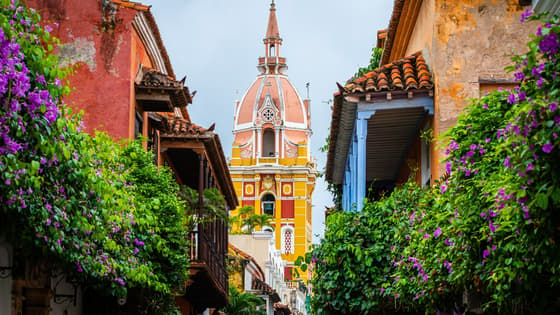
A sightseeing tour of the city could begin in the historic quarter—a UNESCO World Heritage Site—with its streets filled with color and fragrance, flower-adorned balconies, and lively squares. Not to be missed is the Clock Tower, one of the city’s landmarks and the main gateway to the historic district. A stroll through the center leads to Plaza de los Coches, Plaza de la Aduana, and—above all—Plaza Santo Domingo, a hub of activity featuring restaurants, bars, and street performers. To delve into Cartagena’s history, a visit to the Castillo de San Felipe de Barajas is well worth it; this imposing Spanish-built fortress is notable for its network of underground tunnels. The Convent La Popa is another highlight; situated at the city’s highest point, it offers a magnificent panoramic view.
Cartagena’s authentic Caribbean character shines through on beaches such as La Blanca and Castillo Grande, though the most stunning ones are undoubtedly those of the Rosario Islands—perfect for a day spent enjoying turquoise waters, snorkeling, and tropical sands. At sunset, a walk along Cartagena’s historic walls offers one of the most breathtaking views of the city and the Caribbean Sea.