
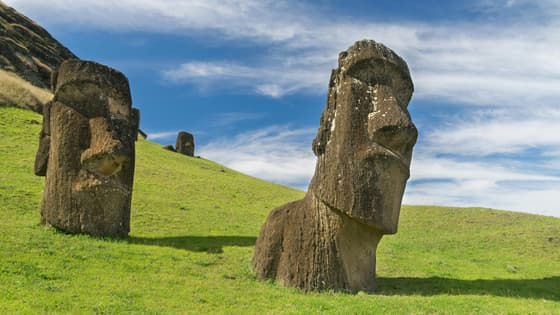
Autumn doesn’t exist on Easter Island. Here, we are in a part of the planet where summer alternates with spring almost continuously, leaving only a few moments of winter cold throughout the year. The seasons on Easter Island are beautiful even when they seem ugly. Experiencing them is a once-in-a-lifetime experience. And it takes a lot of determination to enjoy a vacation here, on a land lost in the middle of the Pacific Ocean… far from everything.
How to get to Easter Island
Airplane is the only useful and valid means of getting to Easter Island. You can also get there by ship, of course, but after months of travel! The small military airport of Mataveri, however, welcomes flights from Santiago Airport (SCL), the most important hub in Chile… the nation to which this tiny patch of volcanic land belongs. The journey, over the vast ocean, takes about 6 hours. So, in order to reach your destination, you’ll first have to overcome the already long journey to Chile and then the transfer to Easter Island. If you are an adventure enthusiast, you’ll definitely love it! The best time to visit the island is between December and March, when the weather is warm and more summery, but in November the climate is cool, slightly rainy, and still pleasant… as if it were April.
What to see on Easter Island
Easter Island is famous for its gigantic lava statues called “moai.” Standing between 5 and 10 meters tall and extremely heavy, they remain a fascinating mystery! How did those primitive tribes sculpt them and transport them to the tops of the hills? Why did they build them? And above all, why did they suddenly stop using (or worshiping) them? There are few answers to these questions… What is left is the beauty of these stern faces staring into the horizon and creating spectacular views at both sunrise and sunset, with the sun penetrating between them.
Another unmissable destination on the island are the caves. Carved out by lava flows during ancient eruptions, these long, twisting grottos hide treasures such as cave paintings and the mysterious Rongorongo signs, hieroglyphics that have not yet been fully decoded. A spectacular hike to the summit of the extinct Rano Kao volcano, overlooking the sea and the islet of Moto Nui, is a must. Once upon a time, young males on the island would brave the waves and sharks to swim to this very rock and steal a Onychoprion Fuscatus bird’s sacred egg. They then had to bring the egg back to the top of the volcano, taking care not to break it during the swim and subsequent climb.
The Modern Island and Tourism
Tourism took hold on Easter Island in the late 1960s. Then, thanks to Kevin Reynolds’ film “Rapa Nui” (1994), it became an increasingly popular destination for enthusiasts and is now well-equipped to accommodate the large crowds of organized tours. Hotels, restaurants, and vacation packages abound.
The only inhabited place is Hanga Roa, with its 7000 inhabitants. The town is the starting point for visiting the moai, the caves, but also Rano Raraku (the place where boulders were carved into the shape of moai), the sacred tombs of Ahu Akahanga and Te Pito Kura, Anakena Beach, and the ancient Orongo arena. Don’t miss the sunsets from Ahu Tahai, a magical spot just a short distance from the port of Hanga Roa.
You can visit many of the places listed here on foot, or choose to ride a bike, slowly and relaxingly enjoying the landscapes and scents along the way.
Extreme adventure? Try the local food
On Easter Island, you eat what you find, what nature chooses to give. The closest continents are hours and hours away by plane, and all around is nothing but sea. Would you dare try the local recipes?
Easter Island food is actually delicious: tuna is a key ingredient and is often eaten in tartare, seasoned with excellent local citrus sauces. Many traditional dishes (meat or fish) are cooked in the oven, using an ancient technique that involves wrapping food in leaves and placing it on and under very hot stones. Last but not least, try Po’e – a dessert made with pumpkin and coconut milk, or the particular Umara, a kind of sweet potato puree.
