
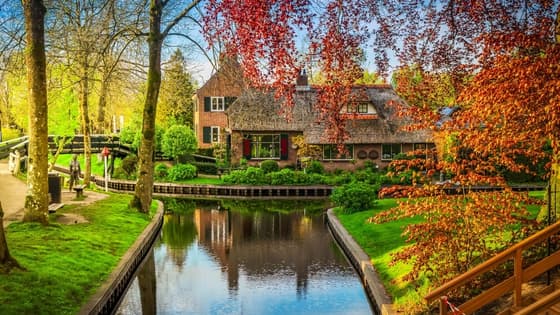
For most tourists, the name “Giethoorn” may not ring a bell. However, mention “Venice” and things start to become clearer. In the Netherlands, this village is known as the “Venice of the North”. Unlike its famous Italian counterpart, however, the atmosphere here is far more tranquil and rural. Instead of grand squares and historic palaces, you will find small wooden bridges, canals, well-tended gardens, and charming thatched-roof houses. While cars are not strictly prohibited, they are restricted to the outskirts, as the historic center is defined by its canals. The Binnenpad – a pedestrian path that winds between houses, gardens, and waterways – serves as the village’s “main street”.
How do you get to Giethoorn, how do you get around?
Located just a few kilometers from Amsterdam and its international airport … and well-connected by both highways and waterways … Giethoorn is becoming an increasingly accessible tourist destination. For a comfortable journey, you might consider hiring a private taxi with a driver. Once you arrive, the best way to explore is, naturally, by boat.
The canals are what make the entire landscape so unique; a boat trip offers a completely different perspective of the houses and bridges. One of the most quintessential experiences is a tour aboard a “whisper boat” – a small, exceptionally quiet electric vessel that you can pilot yourself. Alternatively, you can join an organized cruise, a convenient option for those who prefer to listen to a guide’s commentary without having to worry about navigating the boat. For those looking to organize a boat trip, the Giethoorn Center located in the heart of the village is a great starting point. There are also numerous operators that specialize in renting out electric boats; just ask!
The history of the village
Giethoorn is more than just a picturesque spot; it is also well worth learning about its history . To delve into the village’s past, you can visit the ‘t Olde Maat Uus museum, housed in a traditional, old-style farmhouse.
The museum chronicles the lives of Giethoorn’s inhabitants and sheds light on how the village was shaped by its relationship with water, peat, and agriculture. It is a particularly compelling visit, as it encourages you to see Giethoorn not merely as a tourist destination, but as a community with a long, rich history.
Giethoorn was founded in the 13th century by refugees belonging to a sect known as the “Flagellants,” who found a safe haven in this harsh, marshy environment. By making use of the peat bogs and grazing land for goats (the village’s name actually means “goat’s horn”), they were able to survive and thrive. The village later gained international fame in the 20th century, when it served as the setting for a film directed by Bert Haanstra (in 1958).
What to see in the village
Boating allows you to travel along the Dorpsgracht – Giethoorn’s main canal – passing beneath its distinctive bridges and alongside traditional houses. From the center, you can also reach more open areas, featuring lakes and canals set amidst nature. In the village, in addition to the local history museum, you can visit Museum De Oude Aarde, which is dedicated to minerals, crystals, fossils, and precious stones. The small houses, the quaint church, and the gardens are all part of the village’s charm.
The real surprise, however, lies just outside the village center. Giethoorn is situated within the boundaries of a national park, and you can explore its many trails starting right from the village. Weerribben-Wieden National Park is one of the most significant wetland areas in the Netherlands. The landscape encompasses lakes, canals, ponds, reed beds, wet meadows, and peat bogs – a total of 10,000 hectares of aquatic wilderness! The reed beds, which appear almost everywhere, are the park’s true landmark; the territory can be explored not only by boat but also by bicycle, along wooden walkways and narrow paths. It is an excellent spot for birdwatching, where you can observe numerous bird species and—with a bit of luck—even catch a glimpse of more elusive animals, such as the otter.
Blokzijl and the “water villages”
In the vicinity of Giethoorn, there are several other small, similar settlements worth visiting. One of the most interesting is Blokzijl, an old port town with a history tied to the Zuiderzee. Its center retains a very distinct atmosphere, featuring historic buildings and a harbor that recalls the town’s commercial past. Other stops on a tour of the region could include the villages of Vollenhove, Sint Jansklooster, Wanneperveen, Belt-Schutsloot, Kalenberg, Ossenzijl, and Oldemarkt—perhaps less well-known, but every bit as charming and magical.
Around Giethoorn
About 10 kilometers from Giethoorn lies Steenwijk, which boasts elegant buildings such as Villa Rams Woerthe… an Art Nouveau-style residence surrounded by a large park. Amsterdam is an easy, one-hour drive destination and well worth a visit of at least half a day! Utrecht is just a little further afield, while the fascinating city of Groningen is located 93 km from Giethoorn.
For nature lovers, there is no shortage of options around Giethoorn! Woldberg and Landgoed De Eese forests offer wood trails that are perfect for hiking and cycling. In Marknesse, about 16 kilometers away, you will find the Waterloopbos – a unique park that preserves various scale models once used to study hydraulic engineering projects. In Luttelgeest, there is “Pantropica,” a large indoor tropical environment featuring gardens, butterflies, and nature-focused areas, making it an excellent choice for families. In Kallenkote, you can also visit “Taman Indonesia,” a small zoological and cultural park dedicated to Indonesia.
Planning the ideal itinerary
While Giethoorn can be visited in a single day, staying for at least one night allows you to better soak up the village’s atmosphere and spend more time exploring the natural park. An ideal itinerary might begin with a morning stroll through the historic center, followed by a trip along the canals in a “whisper boat.” After lunch, you might spend the afternoon cycling or exploring the Weerribben-Wieden area.
The following day, you could visit Blokzijl, Steenwijk, or other small local villages—or even venture further afield to larger towns.
Ultimately, Giethoorn is much more than just a picturesque, photogenic village. Its canals, thatched-roof houses, and wooden bridges are merely the starting point for discovering a region defined by water, nature, charming historic centers, and cycling paths. The best way to experience it is by combining boat trips, cycling, and walking—though keep in mind that your comfortable private taxi, complete with a chauffeur, can also help you explore well beyond the boundaries of this “little Venice.”
