What do you do in the summer in Stratford-upon-Avon, the town in the English Midlands where William Shakespeare was born? This is a trip you would usually enjoy in autumn or spring, during school terms, ideal time for cultural excursions. Choosing to do it in summer is a touch of originality that could be rewarding. It could reward you with a cool, gentle climate, while elsewhere the world is scorching hot. It could reward you with a surprise: in fact … who said there’s only Shakespeare here? To reach Stratford-upon-Avon, the closest airport is Birmingham (BHX), just 30 km away; alternatively, after landing at London Heathrow (LHR), about 118 km away (an hour and a half by car, two by train), you can also reach your destination quickly. We offer a reliable chauffeured transfer service from both airports.
The ford in the street
The name Stratford derives from Strete Ford, old English for “ford in the street”, and likely referred to a point where the River Avon narrowed enough to allow easy passage from one bank to the other. It is even suspected that the Romans built a sunken road to facilitate crossing during dry periods, although this is unconfirmed. What is certain, however, is that Stratford began as a Roman military camp and later developed around a monastery. Its strategic location for trade attracted artisans and merchants to the town; they would become the backbone of the local economy. Shakespeare’s father also moved there in order to open a large glove business.
The place where Shakespeare was born and died
William Shakespeare was born in Stratford-upon-Avon on April 23rd, 1564. He was the son of the glovemaker John and grew up in a wealthy family, enough to afford his education. If you go to Henley Street today, you can still admire the house where the great writer was born – although it seems that the building, though perfect in its medieval style, was built in the 19th century on the exact spot where the Shakespeares’ real home once stood.
At just eighteen, young William married a woman eight years older than him, Miss Anna Hathaway, with whom he had three children: Susannah, Hamnet and Judith. Shortly after the birth of his children, all trace of his life disappeared and he reappeared years later in a London theatre. What drove him to leave Stratford is unknown (debts to pay, a more lucrative job, legal troubles?), but Shakespeare’s connection to his hometown remained strong over the years. In fact, he was then buried here, in Stratford, in the 13th-century Church of the Holy Trinity. Not far from the church, today stands a theatre named after him – although built in modern times – and flanked by a small circular theatre, the Swan Theatre .
After a brilliant career as an actor and then as a playwright and director, producing immortal works such as Romeo and Juliet, Macbeth, Hamlet, King Lear, The Tempest, Antony and Cleopatra, Othello, The Merchant of Venice, and many others… William Shakespeare died exactly on his fifty-second birthday, with the loving care of his elder daughter Susannah. The tour of the places linked to the great writer’s life also includes Hall’s Croft, the house where Susannah lived with her husband (although she remained heirless), and the gardens of New Place, located on the site where the house of Shakespeare’s final years once stood.
What else will you see in Stratford-upon-Avon?
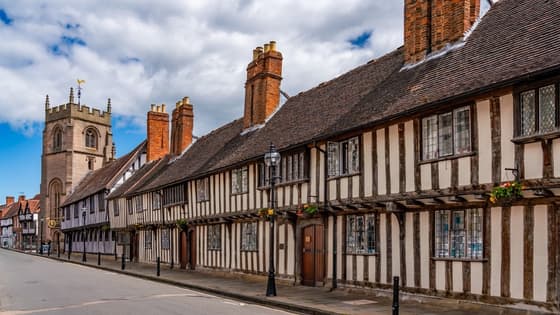
Besides Shakespeare’s sites, the most beautiful monuments to admire in Stratford are the architecture of the historic center, the so-called “Tudor Houses”. Some are originals from the Middle-Ages, others were restored or built later, but always respecting the style of the period: tall houses with pointed roofs, dark beams contrasting with white walls, splendid windows with decorated glass … you’ll admire them almost everywhere, on Sheep Street, High Street, and Henley. Opposite Shakespeare’s birthplace is a unique shop, the Nutcracker Christmas Shop, which sells traditional English Christmas decorations year-round!
Special places to visit in Stratford, besides the ornament shop, are the Teddy Bear Museum, the Butterfly Farm, and the Dirty Duck—an old pub much loved by actors and still frequented by the companies performing at the Shakespeare Theatre. Stratford is a city full of churches. Besides the Holy Trinity, the most important are St. Gregory, Heartlands Church, and Elim Church.
Stratford, center of the world
Based in Shakespeare’s hometown, you shall have all of central England within reach, and Wales is just a stone’s throw away! In less than two hours, you can drive and reach Oxford, Birmingham, and Nottingham. Just a few more minutes’ drive will take you to Bristol and Bath, and if you drive a bit more than two hours, you can also visit central London or, in Wales, the cities of Newport and Cardiff.
If you love nature, head to Gloucester and from there follow the course of the River Severn to its gigantic estuary on England’s west coast. Along the way, you’ll admire two castles, Chepstow Castle and Caldicot Castle, and a magnificent bridge, the Prince of Wales Bridge. Finally, your gaze will be captivated by the vast wilderness of Severn Beach, where you can even swim a little bit. But be careful! Make sure you take information and check the tides carefully, as they can be very dangerous here!
“Stratford’s Sea”
Severn Beach is Stratford’s “sea”. Shakespeare’s fellow citizens come here to enjoy summer relaxation. This small coastal village is famous for its spectacular tides, which can reach some of the highest levels in the world.
A renowned seaside resort since the 19th century, Severn Beach has retained its tranquil atmosphere over time, making it a popular choice for those who want to enjoy the sea without too much noise. The Severn estuary is an important habitat for numerous migratory bird species, making the village an ideal destination for birdwatching. Walks along the coast allow you to observe the unique landscape shaped by the tides and enjoy splendid sunsets “over Wales”! The village has a station where trains connect it directly to Bristol, making it easily accessible for both residents and tourists. The local community, numbering just a few thousand, maintains a strong spirit of collaboration through associations, events, and activities dedicated to residents.
Despite its small size, Severn Beach is an ideal destination for those wishing to discover a lesser-known side of England. And above all, for those who have chosen Stratford-upon-Avon as their summer holiday destination, this place offers that taste of sunbathing that seemed impossible up here in the cold north, but which instead is achieved here, in the heart of a dreamlike landscape.