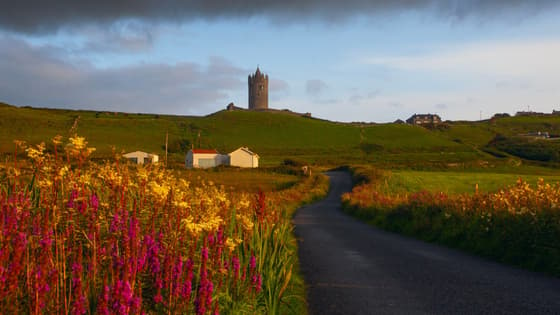
There is a place in Ireland where time has stood still. It has paused at an undefined moment in the past, alongside the oldest Celtic language—preserved here in a state of pure, wild authenticity, much like the landscape itself. These are the Aran Islands, the westernmost outposts lying off the coasts of County Clare and County Galway: Inis Mór (the largest, also known simply as Aran, which gives the archipelago its name), Inis Meáin (the central island), and Inis Oírr (the smallest). Together, they have a population of less than 2,000 people, most of whom live on Inis Mór. Summer is the best time to visit, though September also offers a delightful holiday experience. Highly recommended.
Getting to the Aran Islands: challenging but not impossible
The Aran Islands have three small regional airstrips, though only one—Inis Mór Airport—offers good connections to major Irish hubs such as Galway (GWY) and Dublin (DUB). The islands can also be reached via the Connemara airfield. Our private transfer services make it easy to reach the key airports for your connecting flights to the islands; alternatively, we can take you to the ports of Rossaveel (near Galway) and Doolin (County Clare) to board your ferry. Once on the islands, you can easily get around on foot or by private taxi, or opt for a bicycle—a great way to admire the scenery at a leisurely, stress-free pace.
What might you like to do on the Aran Islands?
There aren’t many activities on the Aran Islands, but the few experiences you do will remain in your memory as truly unique. Hiking through wild, unspoiled nature—like an untouched earthly paradise—horseback rides across green meadows or along coastal paths, observing wildlife in its natural habitat (such as seals) or migratory birds nesting on the cliffs, or taking a trip in an old-fashioned horse-drawn carriage… these are just a few of the options.
Challenge yourself to decipher the incredibly difficult local language, where the English words you know turn into a complete mystery: “island” becomes oilèann or inis, “house” becomes taigh, and “good morning” becomes madainn mhath. Buy the famous Aran sweaters, crafted from a special wool yarn knitted to create unique, three-dimensional patterns.
Inis Mór/Aran
Inis Mór, the largest of the three Aran Islands, is a fascinating destination for those who love nature, history, and Ireland’s rugged landscapes.
One of the most spectacular places to visit is Dún Aonghasa, an ancient prehistoric fort built on a cliff overlooking the Atlantic Ocean. The view from here is truly impressive, especially on clear days. Dún Dúchathair is also worth a visit; it is another stone fort situated in a more secluded and evocative location. To learn about traditional island life, you can visit the Dún Aonghasa Visitor Centre and observe the distinctive stone dwellings and the famous dry-stone walls that divide the fields.
Among the natural attractions, Poll na bPéist—known as the “Wormhole” —stands out: a spectacular rectangular natural pool carved into the rock by the forces of the ocean. Also not to be missed are the island’s beaches and quiet roads, which are ideal for exploring by bicycle. Finally, it is worth stopping in the small villages to taste local specialties and soak up the authentic atmosphere of the Aran Islands. Inis Mór thus offers an experience far removed from mass tourism, blending nature, archaeology, and Gaelic culture.
Inis Meáin
Inis Meáin is the middle island of the Aran group and one of the least populated in the archipelago, characterized by a wild and captivating landscape. The name Inis Meáin means “middle island” in Irish.
The island retains a very traditional atmosphere to this day. The terrain consists mainly of meadows, dry-stone walls, and small roads, while the coastline features cliffs and spectacular views of the Atlantic Ocean. Agriculture and livestock farming have played a vital role in the lives of the islanders for centuries.
Among the island’s most interesting sites are ancient archaeological remains and stone fortifications—witnessing human presence dating back centuries. Examples include Dún Conchuir, an ancient oval-shaped stone fort, and the fortifications of Dún Fearbhaí. The island is also home to Synge’s Cottage, where the famous Irish playwright John Synge lived and worked. Cathaoir Synge (Synge’s Chair) offers a panoramic viewpoint overlooking the entire island and its nearby sister islands.
Inis Oírr
The smallest of the Aran Islands is renowned for its rugged landscape, characterized by dry-stone walls, green meadows, and limestone rock. A walk across this small island reveals ancient monuments such as O’Brien’s Castle and the Church of Saint Caomhán, both set amidst the island’s landscape.
The islanders live in the village of Fromna, a charming settlement beloved by tourists for its traditional dwellings—small stone cottages with thatched roofs. Along the coast lie the remains of the Plassey shipwreck; it sank in 1960 and was never removed, serving as a permanent reminder of the island’s enduring bond with the sea.
Time stands still in the kitchen too
The traditional cuisine of the Aran Islands—located off Ireland’s west coast—reflects the simplicity and character of island life while remaining true to the essence of Irish cooking. The primary ingredients are those readily available on the spot: potatoes, fish, seafood, dairy products, and meat.
The sea has always played a crucial role in the islanders’ diet. Commonly used ingredients include cod, mackerel, salmon, and various types of shellfish and crustaceans. Fish is often cooked simply—baked or grilled—to preserve its natural flavor. Seaweed, traditionally harvested along the coast, is also used in certain dishes. A famous “creamy fish pie” is prepared here by combining the best ingredients the sea has to offer. Potatoes—a staple of Irish cuisine—accompany many dishes on the Aran Islands as well and are prepared in a variety of ways.
Locally produced bread, butter, and cheeses also play an important role. Aran cuisine is not particularly elaborate; it originated from the need to use a limited number of high-quality, nutritious ingredients and the necessity of making the most of available resources. While preserving these traditions, the local culinary scene is trying to significantly evolve and readily incorporates foreign influences. Consequently, in small restaurants and local pubs, one can enjoy simple, wholesome dishes reimagined to suit the tastes of modern chefs.