
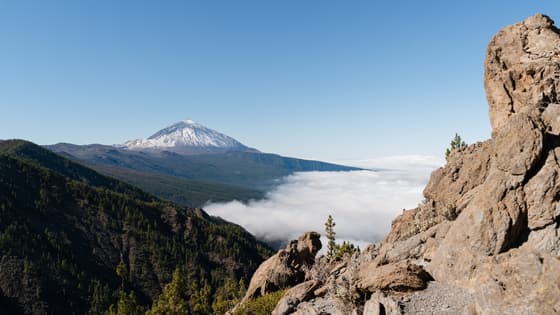
Mount Teide isn’t “just a mountain”: it holds an important record. In fact, it is the highest active volcano in Europe… yes, even higher than Mount Etna, which competes for the title. Etna is actually much more active and vibrant, with frequent eruptions and spectacular explosions, but it is “only” 3,400 meters high. Teide exceeds 3,700 meters in altitude and, although it hasn’t erupted since 1909, its crater is very lively and its steam vents continually emit steam and gases. To admire this natural giant, you must reach it on the island of Tenerife, in the Spanish Canary archipelago, by landing at Tenerife South-Reina Sofia (TFS) or Tenerife North-Los Rodeos (TFN) airports. It will be easy to get from the airports to the volcano, or to any other destination you wish to reach, thanks to the vehicles – with drivers – provided by our service.
The sleeping giant
The Mount Teide volcano rises in the center of the island of Tenerife, as its beating heart. Or rather, a dormant heart… because its activity is limited to a few harmless phenomena. The great mountain is protected by a national park that bears its name and extends over an area of 18,990 hectares. Founded in 1954, it is one of the most beautiful parks in Spain and was declared a UNESCO World Heritage Site in the 1980s.
The park’s territory rises from 1,650 to 3,715 meters, encompassing the Teno, Anaga, and Adeje massifs, with the large caldera of Las Cañadas del Teide at its center. The actual volcano is the peak known as Teide-Pico Viejo.
The name is linked to a legend. According to ancient stories passed down from father to son, an evil spirit (Guayte) once kidnapped the sun and hurled it into the mountain. Then, it engaged in a battle with the good spirits, who obviously won and freed the sun. The word Teide derives from “Echeyde” meaning “house of the guayte” or “house of the devil”.
The inhabitants of Teide
Teide is home to countless plant and animal life. The lack of constant eruptive activity has allowed life to fully adapt to the mountain, although the extremely hot summer temperatures limit the habitat of some species. Over 130 plants have been catalogued around the volcano, among which the “queen” is the Teide Broom (Spartocytisus supranubius) and the Tajinaste (Echium wilpretii). Among the animals, the hawk, the rabbit, the Teide black lizard, and numerous insects—especially spiders—are very common! And…what about humans?
The closest human community to Teide is Vilaflor de Chasna, a municipality of about 2,000 inhabitants located at 1,400 meters asl on the volcano’s southern flank. In this small town, nature is a monument, along with typically Spanish architecture: the Pino Gordo (fat pine) is a centuries-old tree of which the residents are very proud. The Las Vinacas (Wine Grape) Road is a nature trail that leads from the center of the village to a spectacular lookout point, overlooking the volcano and the ocean. Less frequented by tourists, who prefer the more sophisticated seaside towns or the volcano’s wild peaks, Vilaflor offers tranquility and relaxation along with breathtaking views. People treat their proximity to the volcano with respect and often refer to it as “His Majesty”. They aren’t afraid of it; they consider it almost a sacred place. And so should foreigners.
How to climb Teide
Climbing Mount Teide is by no means easy. Highly trained people, already passionate about volcanoes, have made considerable efforts to reach the summit. It’s certainly not a climb for sedentary tourists or simply curious people! You can climb Teide if you have strong legs and a strong heart!
There’s no shortage of guides who will create the best itineraries for you. Even for the lazy and sedentary ones! There are basically two ways to climb this volcano: the “easy-for everyone” itinerary and the “hard-for a select few” one.
The “easy” climb involves reaching 2,356 meters by car or public transport; from there, you take the cable car to an altitude of 3,555 meters (the “Rambleta”); once there, with the help of a guide, you walk to the summit of the volcano. This climb takes a one-hour walk. The “hard” climb starts directly on foot from the Montaña Blanca trail (2,348 meters) up to the summit. The hike takes seven hours over rough terrain, often uphill, under a scorching sun, requiring considerable physical exertion.
Useful Tips
Don’t attempt the Teide climb unless you’re already trained for long outdoor hikes.
Don’t attempt the Teide climb alone.
Dress in layers, as temperatures can range from intense heat to intense cold, depending on the altitude and time of day.
Book your tour with the guides at least three months in advance; demand is high, and summit passes are not easily obtained on site.
