Until thirty years ago, just hearing the name… Medellín… made your bones shake. This word was synonymous with drug trafficking, bloody wars between traffickers, social unrest and terror. Today, all of this seems to have disappeared into thin air, and a new rediscovery of this Colombian city is allowing its rebirth thanks to tourism. Medellín is born again, cleaner, more open, and safer. There are many things to see and interesting itineraries to undertake… preferably in winter (December-March) or in August, during the so-called dry seasons, free of storms and floods. You shall land at the local Medellín-Córdoba Airport (MDE), which also hosts internal flights to and from the capital (Bogota-El Dorado Airport BOG). Upon arrival, we strongly advise you not to rent a car to drive yourself: Colombian roads are difficult and unsafe. It is better to rely on a private transfer with a driver.
Medellín and its dark history
Medellín, Colombia’s second-largest city, has a rich and complex history that reflects the country’s economic, social, and cultural transformations. Located in the Aburrá Valley, region Antioquia, in the Andes Mountains, the city was officially founded in 1675 with the name Villa de Nuestra Señora de la Candelaria de Medellín. At the beginning, it was a small agricultural and commercial center, whose economy was based on livestock farming and the cultivation of local produce.
During the 19th century, Medellín experienced rapid growth thanks to the development of the coffee trade, which became one of Colombia’s main economic resources. Population growth and the construction of modern infrastructure helped strengthen its economic and cultural role. During the 1970s and 1980s, Medellín became sadly famous for the power of the drug cartel led by Pablo Escobar. During that period, the city was the scenario of violence, attacks and conflicts that claimed thousands of lives and compromised Colombia’s security and international image.
Despite these challenges, institutions and civil society embarked on a long journey of rebirth in the following years. Since the 2000s, Medellín has invested in education, innovation, public transportation, and social inclusion. The construction of the subway, cable cars, and the redevelopment of peripheral neighborhoods have fostered the integration of disadvantaged areas and a general recovery of local society.
Medellín in the present: tourism
Today, Medellín is considered one of the most dynamic cities in Latin America. It is an important university, technological, and cultural center, also known for events such as the Feria de las Flores. While preserving the memory of the challenges faced in the past, Medellín looks to the future with a strong focus on sustainable development, innovation, and community participation.
Medellín is known as the “City of Eternal Spring” thanks to its consistently cool climate, which also encourages tourism, as walking is easy here and you can leisurely explore every treasure. Thanks to its recent and extraordinary urban and social transformation, Medellín has relaunched itself internationally as a cultural and leisure hub, finally rooted in sound values.
Famous for its festivals, concerts, and events that enliven the city year-round, it reaches its peak splendor during the Feria de las Flores, a traditional festival filled with parades, music, and floral displays. To savor the culinary delights and, above all, the famous Colombian coffee, there’s nothing better than the cafés in the El Poblado and Laureles neighborhoods. Finally, thanks to its combination of nature, tradition, innovation, and hospitality, Medellín offers an authentic and unforgettable experience, an ideal alternative to a typical trip to Bogotá.
What will you see on your Medellín itinerary?
Medellín is a surprising destination that in recent years has become one of the most interesting places in South America. Its captivating mix of culture, innovation, and nature naturally generates several fascinating itineraries.
Among the must-see attractions is Botero square, in the heart of the city, where twenty-three monumental sculptures donated by Colombian artist Fernando Botero are exhibited. Just a few steps away is the Antioquia Museum , ideal for learning more about the region’s history and art. Another essential stop is Comuna 13, a neighborhood once marked by violence and now a symbol of urban rebirth. Here, you can stroll among colorful murals, watch street artists perform, and easily navigate the six famous escalators that have improved residents’ mobility.
A special thrill can be experienced by admiring the city from above. In order to do so comfortably, take the Metrocable, the cable car integrated into the public transportation system, which connects several hilltop neighborhoods and offers splendid views of the valley. The cable car also takes you to Arvì Park, a vast green space home to some of the country’s typical flora. If you like to immerse yourself in Medellín’s most authentic society, stroll through El Poblado, the city’s most modern and vibrant neighborhood, filled with restaurants, cafes, bars, and boutiques… or go to the Mercado del Río, an ideal place to sample Colombian specialties and international dishes in a contemporary setting.
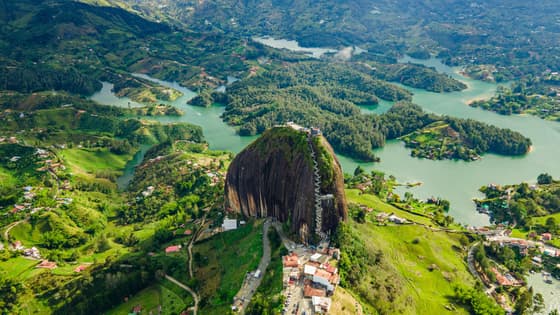
Outside the city, must-see stops include Guatapé, a picturesque village famous for its decorated façades (and the spectacular Piedra del Peñol, a huge monolith offering breathtaking views of the surrounding landscape) and, about a three-hour drive away, Lake Paramo Frontino, not far from the Campanas lagoon.
Be Careful!
Be careful not to give in to the temptation to book a “Drug Tour” or an “Escobar Itinerary”. These are genuine tourist packages, but they are often run by shady agencies or individuals who aren’t entirely compliant with Colombian tourism regulations. In short, you might experience truly powerful emotions, but your money will fall into hands that could use them to finance shady groups.
Street food, the soul of Medellín
While wandering around Medellín, treat yourself to the intense emotions of a taste of the delicious and original street food the city prides itself on. The delicacies you must try are:
Buñuelos: fried cheese balls.
Pandebono: a soft cheese bread.
Papa Rellena: a recipe based on potatoes stuffed with meat and fried.
Chorizo Antioqueño: a sausage seasoned with spices typical of the Medellín region.
Mazorca Desgranada: corn and cheese to go, seasoned with various sauces and meat.
As a drink, try the Lulo juice (from a typical local tropical fruit) or the very strong aniseed liqueur that is somewhat of a trademark of the area.