
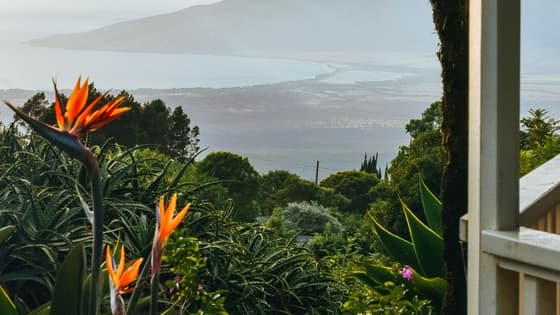
Maui is a mischievous “god.” On a whim, one boring day, he dipped a hook into the ocean and fished out the whole Hawaiian archipelago! Also on a whim, one day, he decided to chain the sun; and when the sun begged him to set it free, he agreed, but only on the condition that the sun would lengthen the days by a few hours. An island is dedicated to this crafty god: it is the second largest in the archipelago after Mother Island Hawaii and home to two volcanoes—Maui (to the west) and Haleakalaa (to the east). Maui hosts a thriving new computer industry but it is certainly best known for its agricultural products and, of course, its beach tourism. While the best time to visit is from April to October, during the winter months Maui’s magic comes alive for a select few… and you can even admire the whales!
Why (and how) to come to Maui in November
Why come to Maui in November? For many reasons. Tourism decreases this month, and the island becomes a true paradise for a select few who can fully experience it without rushing. Because November and December are the months when marine life—humpback whales, for example—approach the coast and humans with less fear. Because temperatures drop from 30 to around 25 degrees Celsius, and rain is not uncommon; if this seems like a nuisance, you must know that only after the rain does Hawaii’s nature offer extraordinary colors and scents.
Reaching Maui in autumn is much easier and quicker. You always land at Honolulu Airport (HNL) on the island of Oahu, and from there you can take domestic flights to Maui’s two small regional airports. Alternatively, you can arrive by boat.
What to see in Maui
You can travel the island from coast to coast in less than 3 hours (to be precise, 2 hours and 35 minutes) by car. The main protagonist of every tourist excursion is nature, which, with two volcanoes, forests, and beaches, undoubtedly dominates every landscape. However, it’s still a pleasure to stop in the towns and discover the ancient traditions of the people, always kind and welcoming.
If your tour starts from the west, the first stop will certainly be the volcano that gives the island its name: Maui is actually a group of mountains created by the collapse of the ancient volcanic edifice; it is, in fact, an extinct volcano that culminates at the 1,700-meter peak of Pu’u Kukui. Behind the volcano lies the lush protected forest of I’hao Valley State Monument, where the “monuments” are the rocky peaks entirely covered in forest that rise above the lava channels. Centrally located between the two volcanoes is Maui’s capital, Kahului, home to museums and universities, which extends along a protected lagoon rich in biodiversity.
Continuing eastwards, you’ll pass through the center of Pukalani, gateway to the tourist trails of the Makawao Protected Forest, and you’ll already be at the foot of Haleakalaa volcano. The heart of a protected national park, the shield volcano that occupies the eastern part of Maui is considered still active, although it erupts intermittently (after long silent decades) and is completely unpredictable. In 2021, it showed signs of awakening, but no major eruptions have materialized. On the east coast, at the foot of Haleakalaa, lies the town of Hana, bravely isolated from the rest of the island’s communities and perhaps for this reason mysterious and fascinating.
The small islands of Molokini, Lanai, and Kaho’olawe, located off the south coast, opposite the town of Kihei, are also part of Maui.
You shall never get bored
You shall never get bored on Maui. Even in November, there’s so much to do. If you don’t want to hike volcanoes or if you’re bored of whale watching, try shopping at the “Trust Kiosks”: these are wooden stalls where farmers leave their garden produce on display, with the price attached. Tourists can take whatever they want, leaving their money in a small box, thus demonstrating their honesty. Even the boxes full of money are a temptation, something to be overcome if you want to maintain the respect of the islanders!
Alternatively, you could sit on the cliffs of Honolua Bay and admire the “Nakalele Vent.” This is a cavity in the rock connected to the sea underground; when the sea is rough and the waves hit the rocks hard, a huge jet of foam comes out of this hole, like a cold geyser!
If you enjoy extreme hiking, walk through the Lava Tube in Hana: carved out by magma during an eruption, it is now a very exciting tourist trail. Maui also offers spectacular boat or helicopter tours that allow you to admire the island from unique vantage points.
Maui Sea
If you want to “enjoy the beach” you’re spoiled for choice: Maui has countless of them! To name just a few: Napili, Kapalua, Ka’hanapali, Kihei, Makena (to the west), Peahi, Hamoa, Keawakapu, and Hana-Black Sands (to the east). The beaches on Lanai’s satellite island are certainly famous, as well. However, we recommend a unique experience: sailing up to the rocky walls of Molokini. This islet is a crescent of ancient lavas, the remnant of a half-submerged volcanic crater. It is located off the southern coast of Maui and home to some of the most beautiful seabeds in the world – ideal for those who also love diving.
