
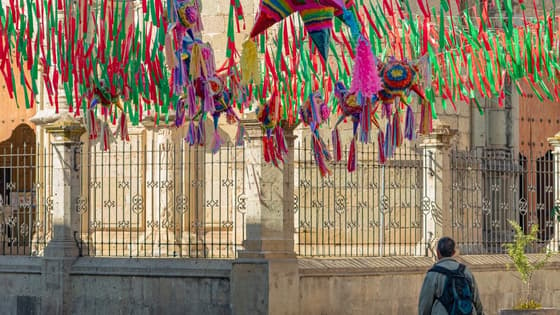
Mexico is a top tourist destination for spring 2026, and since it’s a large nation, choosing your itinerary carefully is essential. Our recommendation—specifically for spring time—is to visit the state of Oaxaca, on the southwest coast. Why Oaxaca? Because here, colors and “fiesta” are everywhere! From the capital, a large “beating heart” located in the center of the state, to the Pacific beaches, ancient ruins and forests, there’s truly a wealth of options for your Mexican vacation.
How to get to Oaxaca
The state and city of Oaxaca can be reached by airplane. Arrive at one of the two major national airports, Mexico City (MEX) or Felipe Angeles (NLU), then connect to Oaxaca Airport (OAX), located a few kilometers from the region’s capital. Ground transportation is always available here: it includes taxis, car rentals, and private transportation with a dedicated driver.
Oaxaca de Juárez
The city of Oaxaca de Juárez, the state capital, was born from “a square league of borrowed land”. In the 16th century, this region belonged entirely to the Spanish Crown and the settlers were simply laborers to be exploited. When some of them requested to buy some land to set up their own business, a dispute arose with the king’s governor, who ultimately granted them only a small portion of land. And on loan, too! Yet from that “borrowed league” arose a city that today has 300,000 inhabitants!
Oaxaca has an ancient historic are now declared a UNESCO World Heritage Site. It also boasts an indigenous soul linked to the Zapotec and Mixtec populations, traces of which still remain visible in the surrounding area.
Your itinerary through the city could include stops such as:
• the cathedral, overlooking the immense square known as El Zócalo, the city’s meeting place, full of shops and traditional eateries, from which the main streets branch off;
• one of these streets, the magnificent Andador Turistico avenue, will surely take you to the Church of Santo Domingo;
• others will lead you to the Botanical Garden and the Museum of Mexican Culture, as well as food markets like Mercado Juárez and Mercado 20 Noviembre;
• also located in the heart of the city, albeit isolated, is Monte Alban—a verdant hill home to the ruins of an ancient Zapotec city;
• if you’re looking for color and tradition, you should visit the neighborhoods of Jalatláco and Xochimilco, where colorful houses, murals, ceramics, and cobblestone streets will immerse you in the true spirit of Mexico.
For a breathtaking view of all of Oaxaca, climb to the top of San Antonio Hill following the Piedra Mona San Antonio de la Cal tourist-hiking trail. It’s a ten-kilometer hike that takes a four-hour walk, with an elevation gain of 550 meters. Just 10 kilometers from the city stands El Tule, a thousand-year-old cypress tree with a trunk so large that at least thirty people would be needed to “hug” it!
Oaxaca and the ocean
Puerto Escondido is undoubtedly the most famous beach in the state. Having become internationally renowned thanks to several films set here, it is also a popular destination for tourists from around the world. The former fishing village now hosts resorts and facilities for water sports lovers ( mainly surfing, windsurfing, diving). The best waves for surfing, however, are at Playa Zicatela, a nearly three-kilometer stretch of golden sand which, in addition to offering giant waves, is also the “summer party capital” of Oaxaca.
If you’re looking for a mix of a relaxing vacation and a natural adventure, look for the small beaches of Carrizalillo and Manialtepec. Carrizalillo is a quiet, crystal-water cove you can reach via a stepped path carved into the rock. The second, a primitive-looking lagoon, should be visited at night because of the phenomenon of “bioluminescence” that occurs on its seabed: when some microorganisms of the algae light up they emit fluorescent blue rays among the waves!
Special Itineraries in the state of Oaxaca
Forty kilometers from the capital lies the archaeological site of Mitla, or “City of the Dead”, dating back to the Zapotec era. The Palace of the Columns, the Arroyo Group, and the Group of Columns are the most important complexes. Don’t miss the chance to hug the “Pillar of Life” a column said to be able to predict your future lifespan based on how close your hands are to each other during the embrace!
Drive 70 km south to enjoy the pampering of a special thermal site: Hierve el Agua, a natural hot spring pool located at the foot of spectacular calcium carbonate waterfalls, whose pure white rock stands out against the greenery of the forest.
A three-and-a-half-hour drive north immerses you in the fascinating world of the Sierra de Juárez. A WWF paradise, these wild mountains are home to small villages reminiscent of Mediterranean Spain architecture.
In the far north of the state, almost on the border with the Guerrero region, lies the historic town of Tezoatlán de Segura y Luna. This very long name pays homage to an ancient indigenous settlement where important battles for Mexican independence were fought—in fact, today it is called “the heroic city”. Not far away is the town of San Sebastián Nicananduta, where, in addition to the many water springs and enchanting hilly landscapes, it’s worth admiring the spectacular, many-coloured cathedral!
