
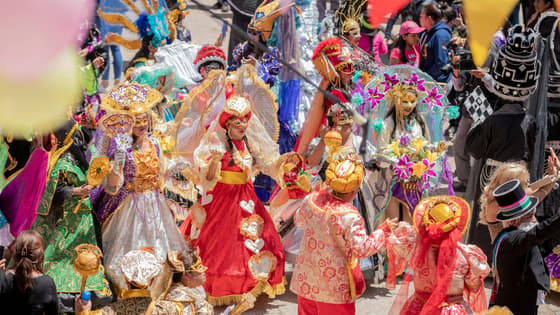
There is a colorful and captivating carnival, in South America, a magical one for both its appearance and unique style. And …no, it’s not the one of Rio de Janeiro! In order to admire it, you have to travel to the Andes mountains, in Bolivia, and specifically to the town of Oruro—also famous for its traditional Indian ballads. Dare to venture beyond the “obvious” and go discover it! The road is long, but not impossible. You land at La Paz International (LPB), the capital of Bolivia’s airport, and from there you can take domestic flights to the regional airports of Cochabamba or Oruro. If you are not comfortable flying on Bolivian airplanes, rely on a chauffeured transfer, like the ones Transfeero offers: from La Paz, in less than four-hours drive via highway, you will get to Oruro.
Oruro: lighthouse of the Andes
Located at over 3,300 meters above sea level in the Andes, the city of Oruro has existed since the 17th century, founded alongside the Spanish mines. However, the site has been inhabited for millennia thanks to the existence of indigenous shrines linked to local cults.
The modern city is less charming than many other Bolivian towns, but it is located in a particularly interesting tourist region. In the city, the most original monument is the Conchupata Lighthouse… a real lighthouse, like those you see near ports, but here located atop a mountain! The first flag of independent Bolivia was raised here in 1851. The cathedral and the shrine of Our Lady of Socavòn are also worth admiring.
Nearby, excursions can be made to the Obrajes hot springs (about 25 km), the prehistoric site of Calacala (30 km), or the lakes of Uru Uru and Poopò. You could also visit Sajama National Park and the Parinacota volcano, although these require considerable driving time, that is several hours.
The Carnival of the Indians
The Oruro Carnival fully expresses the mythological culture of the Aymara and Quechua tribes. After all, the ancient city of “Uru Uru” guarded the power of the gods to whom these people worshipped and was a place of pilgrimage. Here, battles between the spirits of Good and Evil took place and their ancestral rituals were sacred to all. It was after the arrival of the Spaniards and the imposition of Catholicism that these rites were transformed into a carnival. This celebration, “permitted” by the strict laws of the conquerors, hid behind the costumes of saints and demons the ancient ritual that has thus come down to us.
Like all carnivals, the Oruro Carnival also takes place in February/March and begins on Thursday before Mardi Gras. But unlike other carnivals, it ends before the Mardi Gras. On thursday, the celebrations are virtually private, with only true descendants of the Aymara and Quechua people admitted: dancing, parades, and hymns to the nature goddess (Pachamama) take place. The next day, the celebration moves to a cave, the entrance to an ancient mine, where an altar to the ambiguous “Tio de la Mina”—a sort of demon – stands. This god, in local culture, protects against violent deaths. Finally, on saturday, the religious part of the carnival is also celebrated, with hymns to the Virgin of Socavòn at the local shrine, before moving to the city stadium.
The celebration at the stadium is open to all, and anyone can admire the skill of the 50 competing groups of dancers, accompanied by bands that can number up to a thousand members each! A veritable river of crowds, in short, and… “river” in the best sense of the word, because instead of confetti, people throw bags full of water at each other! The most beautiful aspects of this Andean carnival are the original masks, the vibrant colors, but above all the wild dances— such as the Caporales, the Pujllay, and the Diablada, now famous throughout South America
Helpful Tips
Since Oruro is located at over 3,300 meters above sea level, breathing with so little oxygen is difficult. Before unleashing yourself at the carnival, make sure you’re acclimated, perhaps by arriving in the city a few days early.
Book both accommodations and transportation in advance.
Treat yourself to Andean cuisine, which is particularly good in Oruro: Charquekan, a dish of dried meat with boiled corn, potatoes, and eggs; Api con Pastel, cheese-filled fritters dipped in corn tea (Api); taste the rice with goat cheese; fall in love with sugary doughnuts called Chambergos.
PHOTO BY ALEX PEREYRA
