
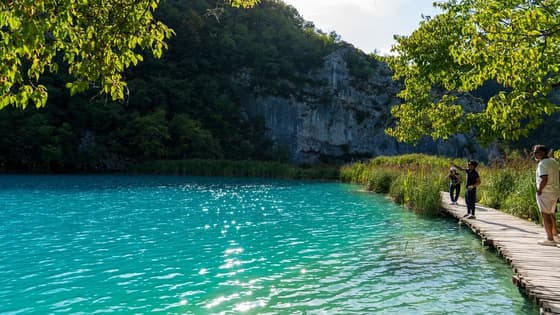
Nestled among the Lička Plješivica mountains, in the heart of Croatia’s wildest and most captivating landscape, lies a cluster of lakes unique in the world: the Plitvice Lakes. Connected by streams and waterfalls amidst a magical, untamed natural setting, these 16 bodies of water—winding their way through ancient forests and rocky terrain—dot a vast 33,000-hectare area with shades of blue. It is a true labyrinth of water, fully deserving of its designation as a UNESCO World Heritage Site in 1979. The best time to visit and admire these lakes is in the spring or during October, when the weather is mild—neither too hot nor excessively rainy.
How do you get to the lakes?
Whether you fly into Zadar Airport, Rijeka Airport, or Split Airport, a quick transfer is all you need to comfortably reach the national park. The journey takes about an hour from Zadar or Rijeka, and two and a half hours from Split; traveling in a comfortable, well-equipped vehicle driven by a professional chauffeur ensures a stress-free trip, complete with useful insights shared by the driver along the way. Once there, accompanied by a local guide, you can explore the lakes on foot while breathing in the scents of the magnificent surrounding nature.
A brief history of the site
The natural environment surrounding the Plitvice Lakes has remained largely pristine, thanks to the ancient peoples who inhabited these forests—tribes known for their fierce reputation. Everyone feared provoking their wrath, and for centuries no one attempted to claim the lakes as their own. With the arrival of the modern era, however, much changed. The Plitvice area was rediscovered as a destination for recreation and sports; by the 19th century, it was already attracting early, modest numbers of hikers and tourists.
Following a visit by Prince Rudolf of Austria and his fiancée Princess Stéphanie of Belgium in 1888, the lakes became a sought-after destination for travelers from across Europe. The lake region was designated a National Park only in 1949, after nearly a century of failed attempts. The lakes are divided into the Gornja Jezera—or “Upper Lakes” (Prošćansko jezero, Ciginovac, Okrugljak, Batinovac, Veliko jezero, Malo jezero, Vir, Galovac, Milino jezero, Gradinsko jezero, Buk, Kozjak)—and the Donja Jezera, or “Lower Lakes” (Milanovac, Gavanovac, Kaluđerovac, Novakovića Brod).
At Plitvice water reigns supreme
Let us step into the park and allow ourselves to be guided by wonder! We quickly discover that the true protagonist here is water. Depending on their depth, the Plitvice lakes reflect sunlight off the lakebed, creating shades that range from emerald green to intense azure and deep blue.
Among the best-known lakes is Kozjak, the largest in the entire complex. Situated between the Upper and Lower Lakes, it is traversed by visitors, often via the electric boat service operating within the park. Another particularly striking attraction is Veliki Slap, known as the Great Waterfall. Standing approximately 78 meters tall, it is one of the iconic sights of the Plitvice Lakes and one of the park’s most photographed viewpoints.
The extraordinary beauty of the Plitvice Lakes is linked to a unique natural phenomenon. Waters rich in calcium carbonate foster the formation of travertine barriers—a type of limestone rock that develops through biological and geological processes. This process continues today, slowly reshaping the landscape. It is precisely this ongoing evolution that makes the Plitvice ecosystem so special. The landscape seen today is the result of an extremely delicate natural balance that must be protected through environmentally responsible tourism.
What to see
In addition to Lake Kozjak and the Veliki Slap waterfall, the must-see attractions within the national park include:
Lake Galovac – located 582 meters above sea level—considered the most beautiful lake, partly due to the series of waterfalls that cascade into it after flowing over travertine barriers. The highest waterfall here drops 16 meters.
Lake Ciginovac – framed by dense forests to the west and a landslide of travertine blocks to the southeast. Situated 626 meters above sea level, it reaches a depth of 11 meters.
The four “Lower Lakes” – all famous for their travertine lakebeds that cause their color to constantly shift and change!
The park offers various hiking routes suited to different durations and difficulty levels. The trails allow visitors to view the lakes from diverse perspectives and traverse woodlands and walkways suspended over the water. For those wishing to explore a larger area of the park, some excursions combine walking, boat trips on Lake Kozjak, and rides on the panoramic shuttle train. Consequently, the duration of the visit can vary significantly depending on the chosen itinerary.
How much time is needed to visit Plitvice?
The time required to visit Plitvice Lakes depends on the chosen itinerary. You can spend just a few hours in the park for a quick visit, though it is preferable to set aside a full day to explore the main viewpoints and the various lake levels at a more leisurely pace.
Those who enjoy walking and wish to experience the area without rushing can devote even more time to the site by choosing longer routes. Before setting off, it is always advisable to check opening times, entrances, available routes, and trail conditions on the park’s official website, as certain services and itineraries may vary depending on the season and weather conditions.
An unmissable experience in Croatia
Plitvice Lakes is a place where water, rock, and forest coexist to create one of Croatia’s most spectacular natural landscapes. For anyone planning a trip to this region, a visit to Plitvice Lakes National Park is an experience not to be missed. Nature, hiking, photography, and breathtaking scenery come together in a protected environment of exceptional beauty.
A holiday at Plitvice Lakes, Croatia, offers a special opportunity to break away from the daily routine and fully immerse yourself in nature. Visiting this magnificent national park allows you, above all, to relax and rediscover an authentic connection with the environment. Walking along the trails and watching the water change color with the shifting light is an evocative experience that inspires both tranquility and wonder.
A trip to Plitvice Lakes is also culturally and educationally significant, offering a chance to learn more about biodiversity and understand the vital importance of protecting natural environments. Indeed, spending time in such a unique park can foster a deeper respect for our planet.
