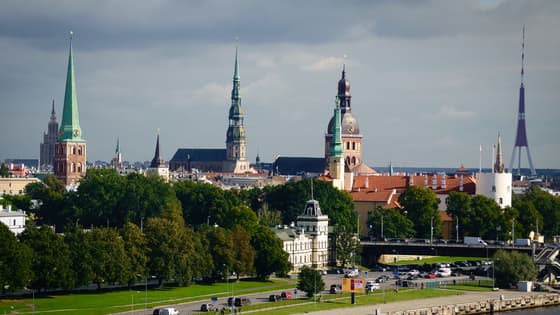
Riga, the capital of Latvia, has a precise date of origin: August 18th, 1201. It was founded by the German Bishop Albrecht von Buxthoeven of Bremen, who sought to establish a base there to evangelize and Germanize the region, which was then inhabited by pagan Baltic people. Thanks to the wealth of the German clergy, a settlement quickly grew around the first church, evolving into a full-fledged city by the end of the 13th century. Until 1900s, Riga’s population consisted of a German majority alongside Baltic and Jewish minorities. Everything was transformed by World War 2 and the epochal changes that followed—affecting not only Latvia but all the regions north of Russia.
Rebirth after independence
Latvia regained its independence following the collapse of Soviet rule in 1991. Since then, it has opened up to the world, and the world has rediscovered it. Today, tourism is a key economic driver for the small republic, alongside trade (with the Port of Riga playing a crucial role) and industrial and pharmaceutical productions.
In terms of tourism, Riga leads the way, although Latvia as a whole offers fascinating sights and destinations. Riga sits at the crossroads of three major international routes—the E22, E67, and E77—and is served by a modern international airport (RIX). The airport enjoys excellent connectivity, including private chauffeur-driven taxi services tailored to every need. Our airport transfer services allow you to explore the Latvian capital and many other destinations with ease.
Exploring Riga…
Riga is an elegant, vibrant city, renowned above all for its Art Nouveau architecture and Nordic atmosphere. As it is relatively compact, the city can be easily explored on foot. Cycling is also a great alternative, especially during the milder months.
The heart of the city is the historic quarter Vecrīga, which was declared a UNESCO World Heritage Site in 1997. Here, amidst cobblestone streets, charming squares, fountains, and splendid architecture, you can admire gems such as the House of the Blackheads, the Cathedral, St. Peter’s Church—whose tower offers a beautiful panoramic view—and St. James’s Church. Another must-see is the Cat House, a building in the city center named after the statue of a cat perched on the roof’s peak; it is sculpted in a comical pose, clinging to the structure as if trying not to fall. However, Riga’s true jewel is the Art Nouveau district—particularly the stretch between Alberta and Elizabetes streets—characterized by richly decorated facades.
Among the many architectural highlights, the “Three Brothers” deserve special attention: these are three ancient buildings standing side-by-side just steps from the cathedral, at numbers 17 – 21 of Maza Pils Street; one of them houses the Latvian Museum. The Powder Tower (14th century) is also well worth a visit. The Castle of Riga, instead, is not always open to the public, as it currently serves as the official residence of the President of the Republic.
For a break amidst greenery, you can stroll through Esplanade Park or along the canal that encircles part of the city center, while Riga’s Central Market is the perfect place to discover local products and specialties.
What to visit in the surrounding area?
Thanks to the chauffeur-driven transfers we provide, you can extend your visit to Riga also to the regions surrounding the capital. We particularly recommend excursions into the natural landscape—whether inland or by the sea—as they offer truly incredible experiences. Just half an hour from the city center, enjoy the beauty of the Babītes Ezers lagoon near Mārupe. Many bird species nest here, and the sunset casts unique hues across the lake waters, which are framed by wild vegetation. For sea lovers, the ideal destination is Jūrmala, located about 30 kilometers from the capital. This elegant seaside resort is famous for its long sandy beach, wooden villas, and relaxed atmosphere. It is the perfect place for a stroll along the waterfront or to spend a few hours away from the city’s hustle and bustle.
One of the most picturesque destinations not far from Riga is Sigulda, located about an hour’s drive away. Known as “Latvian Switzerland“, it offers stunning scenery within the Gauja River valley. Highlights include the medieval Sigulda Castle, Turaida Castle, and walks in the local National Park. In autumn, the forests take on particularly spectacular colors. Another interesting excursion leads to Cēsis, a historic town dominated by the ruins of an imposing medieval castle. The historic center, with its quiet streets and ancient buildings, is well worth a visit. Be sure not to miss the elegant royal city of Jelgava, located about 47 km from Riga.
A two-and-a-half-hour journey toward the western coast brings you to a lovely seaside town, Ventspills: split in two by the Venta River, it boasts a harbor that benefits from warm currents, meaning it never freezes and remains operational all year round! The historic area is divided in two parts: the oldest section, home to the castle, is called “Pilseta” (meaning “city”), while across the river—in “Parventa” (“across the Venta”)—the landscape opens up, with houses set amidst parks and gardens.
Ķemeri National Park
A rejuvenating nature experience awaits just a short distance from the capital at Ķemeri National Park. Located right next to Jūrmala Beach, the park is renowned for its wildlife and its wooden boardwalks, which allow visitors to explore pristine landscapes and observe the local fauna. It is an ideal destination for photography enthusiasts and walkers alike.
Established in 1997, the national park covers approximately 38,000 hectares of the Latvian coast. Its terrain encompasses peat bogs, coastal sand dunes, alkaline fens, and marshes, as well as sulfurous thermal springs—all blanketed by an ancient forest. Perhaps the most stunning spot is the Great Ķemeri Bog (Lielais Ķemeru tīrelis); dating back some 10,000 years to the last Ice Age, it is dotted with pools of reddish water. The flora includes carnivorous plants, mosses, and algae, while the fauna features dragonflies, migratory birds, and small mammals. To take it all in, visitors can walk along a massive circular boardwalk that forms a loop, offering direct views of the park’s most beautiful scenery.
The best time to visit Ķemeri (as well as the city of Riga) is autumn.