
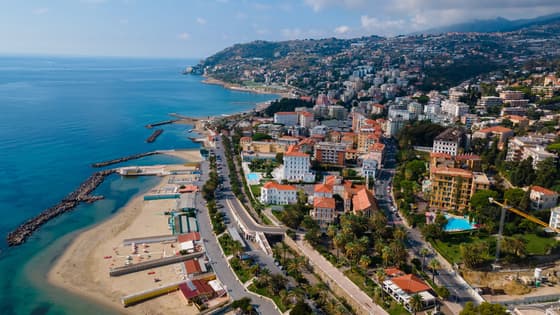
Forget the famous Italian Song Festival for a moment. Forget the sunny beaches and summer nightlife. Come this autumn to rediscover the city of Sanremo from a new perspective, focusing on the urban place itself, not its stereotypes. Because… “Sanremo is Sanremo,” and it remains beautiful even without the fame. The largest municipality in its district (Imperia), it is also the second most populous in the Liguria region, after Genoa. These two records add to its innate prestige.
It all began with a pine cone
The very first nucleus of the city of Sanremo, in the 10th century, was “La Pigna” (pine cone), today a hilltop neighborhood clustered around the Madonna della Costa shrine – although the ancient Romans had already chosen this coastline for their villas. Exposed to enemy attacks from the sea, the medieval town was fortified with a castle—Castrum Sancti Romuli—in memory of the courageous bishop St Romolo, who had supported the inhabitants during battle. Its compact shape, designed specifically to protect the heart of the town, made it resemble a pine cone, hence its name.
From San Romolo to San Remo
It seems a bit like a rerun of the history of Rome, the one that gave the city its current name. How did they go from Romulo to Remo? Over time, the inhabitants of Castro San Romolo became excellent sailors, fishermen, and explorers. The sea became such their perfect element that they seemed to fly on their boats. A famous saying has it: “the inhabitants of San Romolo know how to sail san remo” (without an oar). And over the centuries, that nickname “san remo” became the true – and current – name.
Tourist Fame
The city of Sanremo became a tourist destination starting in the 19th century. The first to discover it was Tsarina Maria Alexandrovna, who came there in 1864 to recover her health in the sun and warmth of the Riviera. She liked the area so much that she invited other Russian nobles to follow her example. The composer Tchaikovsky also made Sanremo his “summer home.” Austrian Princess Sissi, as well as prominent politicians and artists, also lived here, making the Riviera a major seaside resort in the following years. The flower industry, the founding of the Casino, and the song festival – that is held there since 1951 – completed the scenario.
But Sanremo is… much more
Sanremo, however, goes beyond flowers, Casino, and the beaches. Strolling through the streets of this sun-kissed city, you’ll admire fairytale architecture: golden Orthodox domes, Art Nouveau oddities, medieval elegance… particularly visible in the churches. The opulence of the Orthodox Basilica of Christ the Saviour seems to reproduce, on a smaller scale, the grandeur of Moscow’s churches. It contrasts with the stone simplicity of the 12th-century Co-Cathedral of St Siro and the Hermitage of St Michael. The Madonna della Costa church, although it was the first inhabited nucleus of Sanremo, today boasts Baroque architecture restored in the 17th century.
The palaces and villas offer such an interesting architectural panorama that they deserve dedicated tours. Villa Zirio, Villa Cavaradossi, and Villa Nobel… with their palm gardens, are reminders of the wealth of the founders; Villa Ormond is a little paradise itself, thanks to its immense and varied park; and again… Villa Stefania, Villa del Sole, Villa Belrespiro, and Palazzo Riviera.
Among the architecture of Sanremo, the ancient defensive towers also stand out: Torre Santa Tecla, Torre dell’Arma, and Torre Ciapela. The panorama is completed by modern forts linked to the two world wars.
Ancient Sanremo
Did you know that Sanremo also has archaeological sites? The most important is Villa Matutia, also known as the Roman Villa of Foce. Unearthed in the 1920s, next to the municipal cemetery, it consists of the ruins of an early Christian (2nd century AD) rustic dwelling that extends to the coast and even to the seabed. The floors, foundations, and some service areas (toilets, servants’ quarters, and baths) remain.
Another Roman Villa in Bussana is merely a walled perimeter that belonged to a 1st-century AD holiday home. The walls, however, include an ancient furnace and a decorated tomb. Not far from Sanremo, although outside the municipal area, stands the Nervia amphitheater.
How to reach Sanremo and its surroundings
Beyond the center of Sanremo, you can visit coastal and hilltop towns where the splendid Ligurian nature is enhanced in all its colors. Climbing up to the village of San Romolo, visiting Castellara, Verezzo, or Ceriana is definitely worth the trip. Enjoying Termini Bay or reaching nearby Bordighera or Santo Stefano al Mare on the coast is an attractive alternative.
In order to reach all these locations, the reference airport is Genoa (GOA) located 145 km away with a journey time of approximately two hours; you can also land at Nice-Côte d’Azur Airport (NCE), in France, which is only 65 km -and 50 minutes drive- away with the convenient private transfers provided by Transfeero.
