
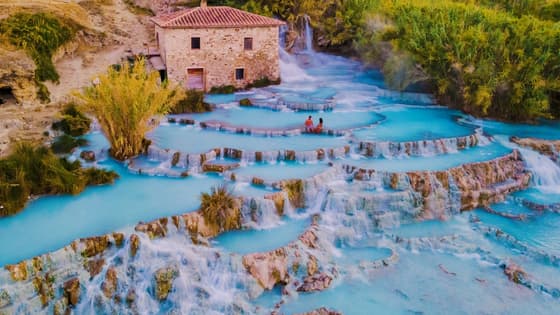
Close your eyes for a moment and imagine… the paradise. A feeling rather than a place— well-being, relaxation, gentleness, fragrance, and wonder. Now, open your eyes and book a thermal spa getaway at the pools of Saturnia, in the municipality of Manciano (Grosseto), Tuscany. What greets you upon arrival will truly resemble the paradise you imagined, both in the sensations it evokes and the scenery itself. A series of natural pools going from a hilltop to the valley below, fed by warm waters flowing from a single source. While the main spring is now an integral part of the hotel and spa complex, the pools known as the “Mill Pools” (del Mulino)—named after a beautiful, restored ancient mill—are open to the public for free. It is the perfect vacation to experience in autumn!
Thermal springs and a god’s wrath
Saturnia has existed since the time of the ancient Romans. Legend has it that the god Saturn—annoyed by mankind’s ceaseless wars—hurled a powerful lightning bolt, opening a crater from which hot water began to gush. Thanks to these waters, people relaxed and stopped fighting one another. Since then, the site has borne the god’s name, reminding everyone who immerses themselves in the pools of that ancient wrath transformed into well-being. A tradition that has continued for over two thousand years, now.
After a long period of neglect lasting from the 13th to the 16th century, the springs were restored and developed starting in 1572. By the 18th century, the site was already a major tourist destination, and from the 19th century onwards, it gained worldwide renown. Public authorities have managed the Saturnia thermal baths since 1946, although many private establishments still cluster—above all—around the natural pools.
A visit to the spa
The water at the Saturnia thermal baths originates deep within Mount Amiata—an ancient, extinct volcano—and travels 40 km before flowing into the pools. The water (with a temperature of around 38°C) flows at a rate of 800 liters per second, with a complete turnover every eight hours. This ensures the pools remain pristine, despite the high number of visitors.
The mineral properties of these waters have long been known to help alleviate joint issues, inflammation, immune system deficiencies, and signs of skin aging. The action of the sulfur-rich water, combined with the “bioplankton” that develops in the pools, helps to “stimulate basal metabolism, reduce water retention, reactivate capillary circulation, and boost liver cell activity—resulting in lower blood sugar levels, increased bile production for fat digestion, and reduced intestinal absorption of cholesterol,” as stated on the facility’s official website .
The thermal complex offers well-established, fully equipped tourism and wellness facilities—though, naturally, stays and treatments have a cost. Alternatively, visitors can enjoy the free natural pools at the “Cascate del Mulino”; a large parking area, a café-restaurant just 20 meters away, and numerous nearby B&Bs and farmhouses provide accommodation and services for those wishing to bathe in these miraculous waters. Between a relaxing swim and a professional treatment, there is a whole corner of Tuscany waiting to be discovered…
How do you get to the spa?
The international airports closest to the Saturnia thermal baths are—in order—Pisa Airport (a one-and-a-half-hour journey), Rome Ciampino (about two hours away), and finally Florence Airport (a three-hour drive). All these airports are served by excellent private transfer options, such as our chauffeur-driven vehicles, which are ready to assist you.
Is it worth staying in Manciano?
The Saturnia spa are located in the small town of Manciano, home to just over 6,000 residents. Is it worth focusing on this enchanting little spot? Most certainly. Though small, Manciano offers truly unique and beautiful corners. Dominated by the quintessential castle—the Rocca Aldobrandesca, which now houses the town hall—the village sits atop a hill rising from the Albegna Valley and has preserved both its original medieval appearance and remnants of earlier architecture.
Dating back to the Roman age are the walls of Saturnia (2nd century), while the walls of Montemerano (12th century) and the historic center (13th century) have since been incorporated into the village houses—which, in fact, resemble small fortifications themselves! A fortress similar to the one housing the town hall—the Fortezza Saturnia—stands to the west of the historic core. Numerous castles and “fortified palaces” dot the surrounding countryside, including several historic estates: Pelagone, Castello di Scerpena, Castello Stachilagi at Marsiliana, Fattoria Campigliola, and Rocca Montauto.
Manciano also boasts many archaeological sites, such as the “Castellum” at Poggio Murella, four necropolises, and an isolated chamber tomb. Lake Tafone and the Montauto Nature Reserve are also located within the municipal territory.
Itineraries in the surrounding area
Whether you base yourself in Manciano or at the Saturnia thermal baths, there are many directions to take for fascinating excursions. In terms of nature, Mount Amiata is just over an hour’s drive away, offering panoramic views and trails for sports enthusiasts. A one-hour drive east brings you to the shores of Lake Bolsena or the Monte Rufeno Nature Reserve in the Lazio region. Montalto di Castro and Porto Ercole, with their popular tourist beaches, are also within easy reach.
Grosseto, the provincial capital, lies 60 km from the thermal baths. Situated in the heart of the Tuscan Maremma Plain, Grosseto is rich in history, culture, and striking landscapes. Its historic quarter is enclosed by the imposing Medici Walls, which are perfect for a scenic stroll. A standout among the city’s monuments is the Cathedral of St Lorenzo, distinguished by its beautiful white and pink marble façade. The Archaeological and Art Museum of the Maremma is also worth a visit, housing significant artifacts related to the area’s history. The Maremma Regional Park and the splendid beaches of the Maremma coast are located not far from the city centre.
Viterbo is situated at roughly the same distance, just across the border in Lazio; here, a must-see is the San Pellegrino district, characterized by narrow alleys, archways, and ancient stone houses that retain their medieval charm. Piazza San Lorenzo lies in the heart of the city, home to the Cathedral and the Papal Palace—an important historical site for the Church, as several papal conclaves took place there during the 13th century. The Civic Museum is another highlight, preserving artworks and archaeological finds linked to the local history. For a relaxing walk, you can visit the Parco dei Papi.
Florence, on the other hand, is further away, requiring a journey of at least three hours from the Saturnia thermal baths. However, if your spa stay is a long one, you can easily dedicate a day to the classic tour of Florence’s wonders, knowing that your physical efforts will be rewarded—upon your return—by relaxing baths in warm, healing waters.
