If your summer plans include a vacation in Sicily, on Mount Etna, but you don’t want to incur the excessive costs of traditional tourist destinations—Taormina, Giardini, or Catania—head to the Land of Acis, a district that is still little-known, in its entirety, although you’ve certainly heard of (and visited) some of its towns. Acireale, Aci Trezza… are now famous names. But did you know that they’re both part of a much larger area where at least seven other towns also bear the name “Aci”? We’ll take you to discover them with our chauffeured transportation, taxis or shuttles, picking you up directly from the main Sicilian airports, Catania Fontanarossa (CTA) or Palermo Falcone Borsellino (PMO). Catania is the closest airport, in fact, it is only 20 km from the Acis. By basing yourself in one of these towns, you’ll have Mount Etna within reach (less than an hour’s drive) and affordable prices for food and accommodation.
Why is it called the Land of Acis?
There are many mysteries surrounding this word, which involves a cluster of towns and villages with the same name. Two explanations attempt to make sense of this “Aci”—which, in these places, is also linked to the myth of the young Greek shepherd Akis, who fell in love with the sea nymph Galatea and was mercilessly killed by the Cyclops Polyphemus (as narrated by Ovid). Both explanations have a common thread: the era of the Roman Empire.
It seems, in fact, that it was the Romans who named these lands “Aquis” due to the rich presence of streams and aquifers, the most important of which is an underground river , still existing, called Aquis. Other explanations, however, hold that this was the land of a noble consul named Aquilio, precisely because he willingly granted his rich waters to his neighbors. From Aquis, or Aquilio, it’s a short step to Akis and then Acis. An Arabic nickname also creeps in, Al Jag, from which Jagi and then Aci could derive.
In the Middle Ages, this land saw the birth of several settlements, all centered around the largest city, called Aquilia. It was only when, in the 17th century, the suburbs separated from the center that the “nine Aci” (or Land of Acis) arose, which have survived to this day. Each of these towns has something beautiful to tell and a traditional, quiet, and welcoming lifestyle. Finding a B&B in one of the Acis will provide you with a convenient base for your excursions to Mount Etna or… why not?… to the sea.
Acireale
The nucleus where it all began was Aquilia, which over time changed its name to Aquium, or Acium. In 1642, the king of Spain, Philip IV, wanted to reward its inhabitants for their loyalty during the war and so named the city a “royal possession” Acium Regale... today Acireale. This is the largest town in the Aci district, with approximately 51,000 inhabitants.
Its center is a jewel of Baroque architecture, with spectacular churches and palaces that recall the reconstruction after the dramatic earthquake of 1693. Piazza Duomo (cathedral square) is the heart of the city: here you’ll find the beautiful Cathedral with its two bell towers, the nearby Basilica of Saints Peter and Paul, and the Town Hall. Not far away is the Basilica of Saint Sebastian, with its finely carved white stone façade, and the nearby Via Dafnica, a street full of Baroque balconies. It is worth admiring the panoramic park of Villa Belvedere, located at the other end of Corso Umberto which leads north from the Cathedral, and the Cammino delle Chiazzette—at the end of Romeo street—a zigzagging path built four hundred years ago that descends the lava hill to the beach. Come to Acireale in August to admire the wonderful floats of the summer carnival, reminiscent of the great Mardi Gras celebration in February, the Most Beautiful Carnival in Sicily.
Among the many hamlets that this large municipality includes is the village of Aci Platani, gathered around the baroque church of Carmel, and famous for a spectacular sacred play dedicated to the Arrival of the Three Kings, on January 6th.
Acis of the Hill
Closely and even physically connected to Acireale, the towns of Aci Catena and Aci Sant’Antonio extend up to the hills surrounding the larger city.
Aci Catena boasts beautiful churches from the Baroque period, such as the Main Church and the Church of Saint Lucy. The latter is located in a neighborhood once called Aci Santa Lucia and used to be a separate village. The heart of the town’s cultural life is the elegant Palace of Prince Riggio, located behind the main church. Just outside the town lies the hamlet of Aci San Filippo, which boasts one of the oldest churches in the area, certainly “the first parish of Aci”.
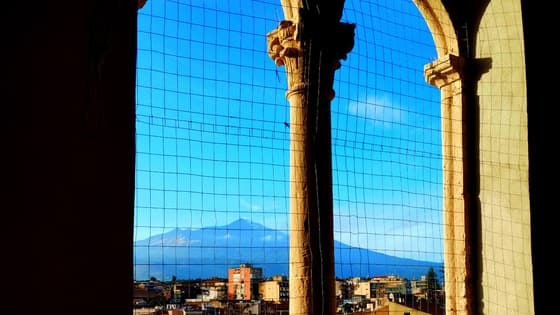
Aci Sant’Antonio is clustered around three beautiful white stone Baroque churches—Saint Antonio Abate, Saint Michael, and Saint Biagio—but is also famous for its artisans who still build and paint Sicilian carts according to ancient tradition. There is also a Cart Museum that tourists especially love. The three hamlets of Aci Sant’Antonio (Santa Maria La Stella, Lavinaio, and Monterosso) are already on the slopes of Mount Etna, and the views they offer of the volcano, especially during eruptions, are unique. The large green area of Bosco di Aci is well worth a visit.
Aci Bonaccorsi: Little Sicilian Switzerland
This small village of 3,000 inhabitants, nestled among the green hills south of the other Aci villages, deserves a special mention. It is called “Little Switzerland” because, unlike many other Sicilian towns, it boasts a very rigorous order and cleanliness. The village’s core is open and airy, with a unique view of Mount Etna which appears between the church of Madonna dell’Indirizzo and Palace Cutore. Two parks flank the large square, and the entire village is made up of houses with gardens, villas, parks, flowerbeds, and floral decorations. The only “monuments” in Aci Bonaccorsi are the many small votive altars scattered throughout the area… but the town is a monument in itself: a hymn to care and attention for the environment and for those who live there.
Acis by the sea
Aci Castello is a delightful town centered around an enormous lava castle, built in the Norman era to protect the coast from enemy attacks. The castle dominates the square and the cliffs below, defying the waves of a beautiful yet restless sea. A famous hamlet in this municipality is Aci Trezza… (the “Trezza of writer Giovanni Verga”, author of the novel “Malavoglia”)… which we’ve already mentioned in the article about the spectacular “U Pisci a Mari” tradition. In Aci Trezza, you can also admire a museum dedicated to cinema and literature, the Casa del Nespolo museum, and an ancient fortified tower literally “hidden” among the houses in the town center. The pride of both Aci Trezza and Aci Castello is the historic Rodolico shipyard – a heritage of the Sicily Region.