
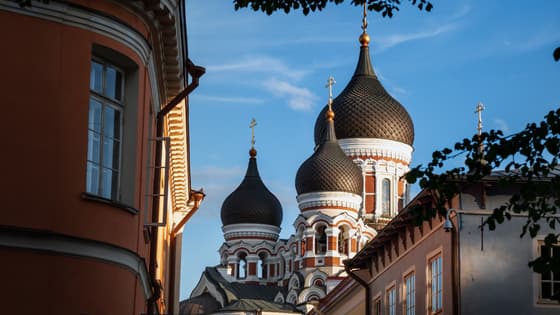
Tallinn, the capital of Estonia, resembles a small Nordic Paris—a city of the north that continues to look toward the far North. It tries to break free from the painful Soviet legacy that once held it back, to emulate the prosperity of nearby Scandinavia (Helsinki, on the opposite coast, is less than three hours away by ferry), and to uphold a centuries-old tradition of maritime trade. Tallinn—a name meaning “castle city”—is elegant and refined; it is never over-the-top, yet far from dull. Come visit it in autumn—that is, now—before the winter frost transforms the landscape.
Getting to and around Tallinn
Reaching Tallinn is incredibly easy and convenient. The Estonian capital is served by its own international airport, Tallinn Airport (TLL) located just 5 km from the historic quarter and well-connected by transport options, including our chauffeur-driven taxis. Alternatively, you could fly into Helsinki Airport (HEL) and take the ferry to Estonia. Getting around Tallinn is simple, thanks to highly efficient public and private transport networks serving all key destinations.
Itinerary ideas for Tallinn
If you are already in Finland, a half-day trip to Tallinn could easily be added to your Helsinki itinerary. However—let’s be honest—half a day isn’t enough to truly appreciate a city with such a unique charm. We recommend staying for at least three days—or up to two weeks, if possible—so you can explore the surrounding areas as well. The best time to plan a trip to Tallinn is undoubtedly late spring or summer, though early autumn also offers a delightful experience in this “Little Paris” of the North.
What should you see in three days?
With three full days in Tallinn, you could organize your time as follows: day one, the historic center; day two, unique neighborhoods and parks; day three, museums.
Among the sights to admire in the historic part of the city, on your first day, Toompea is a must—the castle hill that is home to the cathedral and part of the Old Town. Here, you will visit St. Olaf’s Church, with its 125-meter bell tower (the tallest building in the world during the late 16th and early 17th centuries!), the Town Hall, and the Cathedral dedicated to the Virgin Mary, also known as the Alexander Nevsky Cathedral. You will also see “Kiek in de Kök” , a structure housed within a medieval defensive tower. You will admire monasteries and noble mansions, and have the chance to taste delicacies at traditional local restaurants.
On the second day, start your visit from the “Estonian City”—essentially a “second historic center.” This quarter surrounds the Old Town and retains a distinctly German character, reflecting the heritage of the inhabitants who populated it until the 20th century. Be sure to visit the Rotermann Quarter as well; once a working-class area, it has been revitalized—a prime example of industrial architecture transformed into a beautiful attraction for tourists. Stop at the TV Tower in order to admire the city from above, then relax in parks such as the Botanical Garden or Kadriorg Park.
Dedicate the third day entirely to Tallinn’s finest museums: the Seaplane Harbour (Maritime Museum), the Museum of Occupations and Freedom, the Natural History Museum, the “Second Cathedral” – church of Saints Peter and Paul, the Three Sisters buildings, the Museum of Photography, and Europe’s oldest pharmacy!
What to see in a one-week stay …
You can decide how much time to devote to the city’s various tourist attractions based on your schedule. You can also arrange routes with our drivers, who may be able to offer their own recommendations.
The first stop is always Toompea, a UNESCO World Heritage site. As you stroll through the medieval streets, you can admire Town Hall Square, St. Olaf’s Church, and the city walls. The highest point of Toompea Hill is home to the historic Alexander Nevsky Cathedral and offers viewpoints overlooking the rooftops and the Baltic Sea. You could dedicate a full day to Kadriorg Palace and Park, which also houses Kumu, a major Estonian art museum. For a more modern vibe, the creative districts of Telliskivi and Rotermann are well worth a visit, offering plenty of bars, shops, and galleries.
During the week, you can also explore the port area, the Maritime Museum, and the seaside Noblessner district. One day might be set aside for an excursion to the surrounding area—such as Lahemaa National Park, which is easily accessible from Tallinn. Finally, it is a good idea to leave a few hours free to sample Estonian cuisine, visiting local markets, or soak up the capital’s peaceful atmosphere.
… Or two weeks stay
Within about an hour’s travel from Tallinn, there are diverse locations ideal for half-day or full-day excursions—perfect if you have at least two weeks for your stay.
To the west of the capital lies Keila-Joa, a lush, green area famous for its waterfall (roughly six meters high) and the romantic park surrounding its manor house. It is a delightful spot for a nature walk, especially in autumn. Further along the coast, Laulasmaa is worth a visit, known for its beaches and pine forests; the area offers a picturesque setting for walking along the shore and taking in the Baltic Sea landscape.
To the east of Tallinn lies Jägala, home to one of Estonia’s most spectacular waterfalls. Meanwhile, history enthusiasts can visit Rocca al Mare (a stunning place with an Italian name meaning Sea Rock) —just outside Tallinn’s city center—which hosts a large open-air museum dedicated to Estonian rural life and architecture, featuring historic farmhouses, windmills, and traditional buildings set across a vast green area.
From Tallinn to Helsinki
The proximity of the two cities—separated by only a stretch of sea—makes Helsinki an excellent side trip for anyone staying in Tallinn for more than three days.
The relationship between the cities is also significant for trade and cooperation in the technology and digital sectors. Both Helsinki and Tallinn are renowned for innovation and a commitment to urban sustainability. In recent decades, their closeness has fostered a shared economic and cultural zone across the Gulf of Finland. Consequently, Helsinki and Tallinn stand as a prime example of collaboration between neighboring European capitals.
If you are arriving from Tallinn, Helsinki will welcome you with the same warmth and beauty: the Cathedral, Senate Square, the Suomenlinna fortress, the magnificent Oodi library, Sibelius Park… It is an excursion that has become an integral part of any itinerary covering the Estonian capital. So, be sure to include it in your plans!
