In Avila, there’s no sea, no beaches, no trendy nightlife, and none of Madrid’s grandiose monuments. So why book a vacation here? To experience a unique magic, blending Spanish art, history, and culture in one place and during a major event: the Medieval Days. In order to fully experience these reminiscent days, make sure to book a stay in the city in early September (the event is usually held within the first two weeks, this year for example, from September 3rd to 6th). You will land at Madrid Airport (MAD), which is 123 km away and just over an hour’s drive; alternatively, you can fly to Salamanca Airport (SLM), which is just 75 km away. Both are excellently served by public transportation and our chauffeured transfers.
September in Spain
Vacationing in Spain in September is an ideal choice for those who want to enjoy the country’s beauty without the chaos typical of the tourist season, especially without the sultry temperatures and risk of fires. During this time, the days are warm but not stifling, generally pleasant, and allow for extended periods outdoors, excursions, and visits to cities of art.
Famous destinations such as Barcelona, Madrid, Seville, Valencia are generally more beautiful in September than in July and August. It is therefore easier to visit museums, monuments, and characteristic neighborhoods without long lines or excessive crowds. And using this month to explore lesser-known but equally beautiful places, perhaps located far from the sea (like Avila, for example), is an excellent idea. After all, September can also be economically advantageous. After the peak summer season, prices for some accommodations and services can drop, allowing you to plan a quality vacation on a more modest budget.
Spain also offers a wide variety of experiences. You can choose between the splendid beaches of the Balearic and Canary Islands, the coasts of Andalusia, or cities rich in history and art. September is also the perfect month to sample Spanish cuisine, from tapas to paella, accompanied by local products and wines, which are now available for tasting thanks to the early summer harvest.
Avila and Santa Teresa
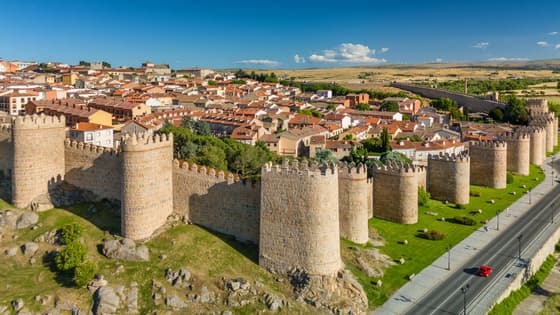
Avila is located in the region of Castile and León, about 110 kilometers from Madrid. Situated at1,100 meters above sea level, it is one of the highest cities in Europe. Its historic central quarter, surrounded by imposing medieval walls with towers and battlements, still retains the appearance of an ancient and evocative city. Avila’s main symbol is in fact its walls, but the entire world associates it with just one name: a saint name, that of its most illustrious citizen.
Saint Teresa of Avila, born in 1515, was one of the most important figures in Christian spirituality. She entered the Carmelite monastery at a very young age and dedicated her life to prayer, meditation, and the reform of religious life. Together with Saint John of the Cross, she promoted a reform of the Carmelite Order, founding the Discalced Carmelites. Teresa recounted her spiritual experiences in famous works such as “The Book of My Life,” “The Interior Castle,” and “The Path of Perfection”. Teresa was a very determined woman, capable of facing difficulties and opposition. She died in 1582 and was declared a saint in 1622. In 1970, Pope Paul VI proclaimed her, along with Saint Catherine of Siena, the first female Doctors of the Catholic Church.
Of course, the Convent of Saint Teresa of Avila is one of the most visited places for religious tourism, and not only that. Overlooking an airy square, the convent boasts an elegant carved stone façade and an unusual layout, oriented north—rather than east—to give centrality to the room where the saint lived. The building is actually constructed on the site of the birthplace of Saint Teresa’s family.
What to admire in Avila?
Avila is an ideal destination for those who love history, art, and architecture. Its walls, religious monuments, and connection to Teresa of Avila recount centuries of Spanish history. Visiting Avila means discovering a peaceful and charming city, capable of preserving a valuable historical and cultural heritage to this day.
The historic quarter (a UNESCO World Heritage Site since 1985) offers elegant streets and characteristic squares, narrow alleys and stone buildings that allow visitors to immerse themselves in the atmosphere of medieval Spain. Beyond the sites of Saint Teresa, the main attraction is undoubtedly the medieval walls, built primarily between the 11th and 12th centuries. They are approximately 2.5 kilometers long and feature numerous towers and monumental gates. It is possible to walk along some sections of the walls and admire the city center and the surrounding landscape from above. At sunset, the stone they are built with takes on particularly evocative colors, ranging from pink to gold to orange, making Avila even more fascinating.
Within the walls, the old town houses religious and historical buildings. Among these, the Cathedral of Avila stands out, considered one of the first great Gothic cathedrals in Spain. Its structure is integrated into the city walls and contributes to creating a truly unique architectural ensemble. Among the other buildings, worthy of your admiration are palaces such as the Palacio de los Águilas and the Palacio de los Verdugo – with sculpted portals and stone reliefs – the 17th-century Bishop’s Palace, the Casa del Conde de Oñade, the Casa de Superunda, and the magnificent Velada Palace with a three-story courtyard and an imperial network of beautiful galleries.
Outside the city center, there are fascinating places such as the convent-school of Saint Teresa, Nuestra Señora de Gracia, the Romanesque basilica of San Vicente, the hermitage of San Segundo, and the archaeological sites of Prado de las Cruces and the Old Tanneries.
Medieval Days
Avila’s historic center travels back in time in September for the Medieval Days . Inside and around the famous walls, everything is transformed into a grand medieval setting, as if the calendar had stopped at the time of the Crusades.
The programs vary from year to year, but what remains constant and absolutely characteristic are:
- the more than 300 craft and food stalls;
- the performances of street artists – musicians, painters, and jesters;
- tournaments and fights with swords and lances, both on foot and on horseback;
- falconry and weapons demonstrations;
- theater plays and entertainment.
The heart of the festival is the famous Desfile de las Tres Culturas, the parade of the three cultures, dedicated to the traditions, customs, and songs of the three communities that have always shaped the soul of this city: Christians, Muslims and Jews. Witnessing this spectacle, as every single “day” of the event, is an emotion that reconnects not only with history but also with one’s own sense of humanity. Don’t miss the chance to see it!