
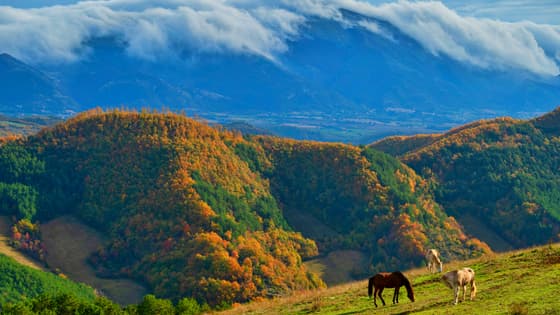
If you are planning a unique getaway for the upcoming cold season, we suggest heading south … but to a part of the south you may have never encountered: the mountains of Campania. When people think of the region – home to Naples, the Amalfi Coast, and the islands – they typically envision a summer filled with brilliant light, sea, sun, warmth, crowds, and ultra-luxurious hotels. Yet, just a few kilometers across the hills, behind Amalfi, the landscape shifts, as do the traditions, colors, sounds, and even the people. This is the “other” Campania: a land of mountain peaks, forests, water streams, and ancient villages that have risen anew following the many earthquakes.
Heading to the Apennine Ranges…
To reach the Campanian Apennine Ranges, visitors can fly into Naples Airport (the closest one), Bari (about a two-and-a-half-hour drive away), or Rome Fiumicino (a three-hour journey by motorway). While these locations are connected to the area by bus and train services, renting a car is often more convenient. However, given the complex nature of the mountain roads in this region, the best option is to hire a private taxi with a dedicated driver to cater to your specific travel needs. With one of our vehicles, for instance, reaching the Campanian Apennines becomes an easy, comfortable, and relaxing experience.
The Campanian Apennines consist of a mountain range stretching from Molise to Basilicata, reaching its highest point (Mount Cervialto, in the Picentini range) at an elevation of 1,809 meters asl. On the map, the area is divided into three groups: Taburno Camposauro, Partenio, and the Picentini. The first is a massif located in the district of Benevento, surrounded by lower peaks; the Partenio mountains are in the Avellino area, while the Picentini lie closer to the coast, between Avellino and Salerno.
Mount Taburno: what secrets does it hide?
Taburno Camposauro is a 1,394-meter-high massif that dominates both the nearby Partenio mountains and the Caudina Valley. Clearly visible from Benevento and the neighboring sub-region of Irpinia, the massif and its peaks form the silhouette of a reclining woman, known locally as “the Sleeping Lady of Samnites” (la Dormiente del Sannio). Rich in downy oak and beech forests, the area displays extraordinary colors in the autumn and is home to an interesting array of wildlife, most notably the wolf.
Benevento serves as the primary city for this territory – a place steeped in history, culture, art, and tradition, which still preserves traces of the various civilizations that have inhabited it over the centuries. Founded by the ancient Samnites people, Benevento later became an important Roman center. One of its most famous monuments is the Arch of Trajan, built in the 2nd century AD in honor of the Emperor Trajan. Another relic from that historical period is the Roman Theater. With its UNESCO World Heritage sites (such as the Church of Santa Sofia, Sant’Ilario, the Leproso Bridge, Palazzo Rotondi, and the Rocca dei Rettori) and its folklore surrounding mysterious witches, Benevento is a fascinating base for a holiday.
The mountain villages that dot the slopes of Mount Taburno compete with one another – especially during the Christmas season – to showcase their beauty. It is worth visiting Bonea, in the heart of the Caudine Valley, Montesarchio with its castle, and Sant’Agata dei Goti with its ancient churches.
The trails of the Partenio
The Partenio Mountains take their name from Montevergine (parthenos) – the highest peak – and the sanctuary of the same name located there. They are also known as the Avella Mountains, from which the nearby city of Avellino derives its name. The mountain range features gentler, more rounded contours, with dense forests of holm oak, beech, and chestnut trees blanketing the landscape in deep shades of green. The foothills are extensively cultivated, producing, among other things, excellent wines such as Fiano d’Avellino.
Those who enjoy walking can explore the Partenio Regional Park, a protected area where trails offer the chance to immerse oneself in pristine landscapes and observe a wide variety of flora and fauna. Notable destinations include Summonte – one of the area’s most beautiful villages – famed for its Angevin Tower, its distinctive historic center, and the paths leading toward Campo San Giovanni. Ospedaletto d’Alpinolo is a small village with deep ties to the tradition of pilgrimages, while in Avella one can admire a Roman amphitheater and the ruins of a medieval castle. Pietrastornina is renowned for the towering rock spire that looms over the village.
At the heart of this region lies Avellino, a city that boasts a rich, ancient history and significant monuments, including the Cathedral, the Clock Tower, the Liguorini Monastery, the Medieval Mill, the Casino del Principe (Prince’s Lodge), and the ruins of the Lombard Castle. Avellino is also known for its quiet, simple way of life and its culinary specialties, such as homemade pasta, cured meats, and cheeses.
The peaks and castles of the Picentini Mountains
These towering, rocky mountains … which seem to almost touch the sky … could easily be called the “Dolomites of the South”. Rich in rivers and forests, they are like a waking dream, especially in winter when they are blanketed in snow. At least five protected areas safeguard the beauty of these peaks and the many villages that dot the landscape.
Salerno – though a coastal city – serves as a primary hub for the region and could certainly be used as a base; it is a beautiful place indeed, but if you are looking for the magic of a different side of Campania, consider staying in a mountain B&B or a farm stay up in the Picentini Mountains, instead! You can find a cozy retreat in Eboli or Bagnoli Irpino, among the waterfalls and woods of Calabritto, or amidst the golden chestnut groves of Montella. Other particularly charming spots include Giffoni Valle Piana – known for its renowned film festival and medieval castle – and Montecorvino Rovella, which preserves traces of its historical past through its churches, quaint alleyways, and ancient buildings.
Make sure to visit the village of Acerno, nestled in the lush green woods, as well as Olevano sul Tusciano, famous for the rock-hewn complex of San Michele Arcangelo, located inside a striking cave. Also, do not miss the chance to admire the beauty of Castiglione del Genovesi, a small, scenic village associated with the philosopher Antonio Genovesi.
A Christmas event not to be missed
A holiday in the Campanian Apennines during this season wouldn’t be complete without a visit to the castle of Ceppaloni (near Benevento), which, as Christmas approaches, is transformed for the festive event “Come d’Incanto” (As If by Magic). The festival is a blend of the sacred and the profane, featuring Christmas lights, Christian symbols, and paths dedicated to the legend of the witches!
