
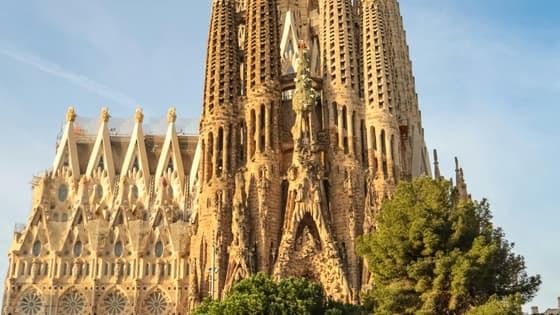
This year, 2026, marks the centenary of the death of Antoni Gaudí, the artist and architect responsible—among many other things—for the final design of Barcelona’s cathedral, the “Sagrada Familia”. If you haven’t yet thought of a destination for your spring break, set your sights on this magical Spanish city, a mass tourism legend especially for its beaches and night life. Getting there is easy, thanks to Barcelona El Prat Airport (BCN), which is connected to the city center by various public transportation options and the customized services we offer at Transfeero.
The “Melting Cathedral”
The Sagrada Familia—full name: Templo Expiatorio de la Sagrada Familia—is one of the most famous churches in the world, despite not yet being completed! Its most striking feature is its architecture, which appears like melting material, so that it is also called “the melting cathedral”.
Work began in 1882, by order of King Alfonso XII of Spain, but the architects in charge of the project disagreed on coordinating their actions and were slow to begin. The young thirty-year-old architect Antoni Gaudí then took over the construction site and revised the designs from the initial Neo-Gothic style to an extreme Art Nouveau style. Despite the initial shock, given the popularity of this style in Barcelona’s historic center at the time, the idea was approved.
It was not easy, however, to practically realize those soft, twisted, and “flowing” shapes. Even though Gaudí himself was always present on site, the work underwent numerous forced pauses and several corrections along the way. The architect would never see his masterpiece built, which, in fact, remains incomplete today, although everything is being done to complete it within the next two years. In 2025, with the completion of the central tower (162 meters high), the Sagrada Familia has become the highest church in the world!
Structure of the Sagrada Familia
The Sagrada Familia has a Latin cross plan with three classical naves and seven side altars; it can comfortably seat 14,000 people. The walls and towering columns are entirely white and take on various hues from the light that enters through the painted glass of the side windows; it is all dominated by a marvelous polychrome rose window in the center.
On the outside, the church boasts eighteen towers topped by as many spires with very soft shapes that almost resemble melting ice cream cones. The decorations consist of bas-reliefs, inlays, peaks, niches, statues, and any other form that “plays” with the sunlight, creating that “stone lace” effect that fascinates everyone gazing at the monument.
The project calls for the church to have three façades, two of which are already visible, while the third is still being completed. The Nativity Façade is the work of Gaudí himself and is richly decorated; dedicated to the birth of Jesus, it showcases a naturalistic style. The Passion Façade stands out for its geometric shapes and statues representing the sufferings of Christ’s martyrdom. The Glory Façade—once completed—will be the cathedral’s official and grandiose entrance.
Celebrating Gaudí…
Antoni Gaudí was born in Riudoms, Catalonia, in 1852. Along with his four siblings, he lived a poor childhood with various health problems. But his brilliant intelligence and, above all, his gift for art opened the doors to higher education, which led him, after his military service, to study architecture in Barcelona. From his 20s to his 30s, he had already completed fascinating and complex projects in the city, and for this reason he was favored as project manager for the Sagrada Familia.
Gaudí died in 1926 in a bus accident. This year, therefore, we remember the tragedy of this brilliant architect, taken from the world too soon but who left behind a legacy of grandiose and “plastic” – that is, “in progress” – works, such as the Sagrada Familia.
To dedicate an entire holiday to Gaudí, in addition to visiting the famous cathedral, also follow the other events organized in the city: exhibition openings, theme tours, architecture workshops, as well as the monuments designed by Gaudí before the Sagrada Familia (Casa Milà, Casa Batlló, Park Güell). The program is available at this link https://consellantonigaudi.cat/en/program-2026/ – but we strongly recommend booking ahead of time, even before leaving for Barcelona.
