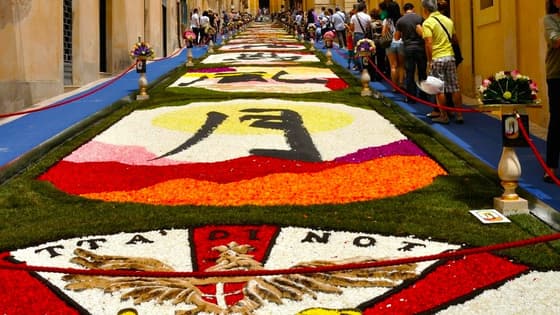
There is a Latin tradition that has been preserved intact for centuries, primarily in Italy but also elsewhere in the Mediterranean basin. It is the tradition of the “infiorata” (flower tapestry) much more than a simple artistic installation: a true celebration of spring. The tradition was born, as often happens, from religion and specifically from the decorations for the feast of Corpus Christi in June. But today it has abandoned that sacred aspect and has become a secular show, open to everyone and everything. In fact, in addition to flowers, other materials such as stones, sand, or confetti are also used. We shall guide you through the most beautiful flower displays of the spring and summer period. Get your cameras ready!
Gerano, the oldest flower tapestry
In Italy, the oldest flower tapestry is that of Gerano (district of Rome). Here, the tradition of decorating an entire street with flower petals originated in the 18th century, in honor of the feast of Our Lady of the Heart—which takes its name from a painting by Sebastiano Conca (1680-1764). Today preserved in the church of the Assumption, legend has it that when it was first brought here in 1729, it was intended to remain there only one night. But when it was time to remove it, thunderstorms and rain raged for a whole week, making the people realize that the painting must remain there forever.
Today, during the Infiorata, the parish priest and the community carry the painting to the altar in the square, walking through the flower tapestry—showing special designs and scenes. The event is usually celebrated on April 25th, but is also repeated on weekends in June.
To reach Gerano, book a customized transfer with us. We will pick you up upon arrival at Rome’s airports ( Fiumicino or Rome Ciampino) or at any train station.
Genazzano, the longest
Genazzano is also located near Rome, and you will land at the same airports. This elongated hilltop village is nestled on a ridge surrounded by greenery and holds the record for hosting the “longest flower tapestry ever”. The tradition takes place in July, here, and has been celebrated since 1883.
The flower carpets are set up in honor of the Feast of the Sacred Heart to embellish the procession route, and uses the petals of thousands of flowers to create wonderful decorations on the asphalt for the participants to walk on. The route starts from D’Amico square in the late afternoon and reaches the outside of Porta Romana, then returns under the portal of the Church of St Paul.
The fantasy of Spello’s flower tapestry
Spello, a small medieval village in Umbria, is known as “the village of photographers” for the sheer beauty of its natural and urban landscapes, and the “ancient” faces of its inhabitants. Here, among crenellated towers, ancient churches, and elegant palaces, one of the most beautiful and imaginative “infiorata” in Italy is organized.
The flower tapestries are arranged in the most picturesque corners and open spaces along the route of the Corpus Christi procession (which falls nine Sundays after Easter) and usually represent sacred, floral, or themed symbols. Each design adapts perfectly to the medieval architecture of the village, and in the evening, with the passing of the procession’s candles, everything takes on a wonderful mystical aura.
Spello is located in the district of Perugia, the regional capital which has its own very busy airport, although most international flights land at the nearby Ancona-Falconara Airport (about an hour and a half away).
The Baroque floral messages of Noto
The queen of Sicilian Baroque is the town of Noto, in the district of Syracuse. Located 88 km from Catania Airport, it is well-served by public transport and our private transfers and is home to one of the most recent and fascinating flower tapestries in Italy.
The Infiorata di Noto, in fact, dates back to the 20th century – specifically the 1980s, and stems from a twinning with one of the historic flower tapestries in Lazio. No one really knows whether Noto had its own flower display, before; the tradition had certainly been lost over time, anyway. Revived forty years ago, it has grown in skill and fame at an incredible rate, now making it one of the most renowned events of the Italian spring. Noto’s floral designs convey powerful social messages and were created to invoke peace, condemn violence against women, and encourage the welcoming of foreigners.
The Noto event takes place on the third weekend of May and unfolds in the historic, central baroque quarter of the city, among the steps and “embroidered” balconies of Via Nicolaci and the cathedral. Unlike the tapestries in Lazio, which are sometimes trampled by participants, Noto’s Infiorata must be admired by walking along the sidewalks, one for ascending and one for descending. It is usually very crowded, especially in the evening, so you have to wait in long lines… but they’re definitely worth it!
Spanish flower tapestry in Tenerife
The tradition of the “Corpus Christi Flower Tapestry” has also remained unchanged in Spain, specifically on the island of Tenerife in the Canary archipelago. Here, between May and June, the art of decorating streets and squares with flowers can be admired in the towns of La Orotava, La Laguna, and Tacoronte.
In La Orotava, the flower carpet usually covers the entire surface of the main square and is complemented by volcanic sand from Mount Teide. Inserted among petals and leaves, it gives the designs more depth. Here too, the tradition is very old (19th century) and linked to Catholic worship, although it was also used to honor the island’s lords. The closest airport to La Orotava Tenerife is Tenerife Norte.