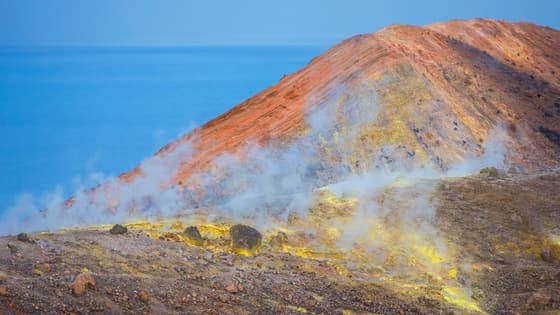
The island of Vulcano does not bear its name because it has a volcano inside; on the contrary, it is precisely because of this island that fire-spewing mountains are all called “volcanoes” . At first sight —so flat and low-lying— you wouldn’t even say it, yet this is a powerful volcano. The fact is that—luckily! —it sleeps for long periods and rarely wakes up. The last eruption dates back to the 19th century, but in the intervening times, activity continues in the form of fumaroles, gas emissions, and bubbling mud. These are the very same muds that locals have used for millennia to treat aches and health issues: the thermal baths of Vulcano.
The island of the dead that heals the living
In the time of the Anient Greeks, it was said that Hephaestus—the god of fire (later known as “Vulcan” in Latin)—lived and worked deep within the earth on the island of Vulcano. The presence of the “divine blacksmith”, with his fires, fumes, and subterranean hammer blows, terrified people, and in the past, no one wanted to live on the island.
Later, it was thought to be the “gateway to Hell”, which is why the bodies of the deceased—especially enemies or the unwanted—were buried or cremated there. Some even performed purification rites on the island to ensure the souls of the dead ones were cleansed of their sins during their passage.
It was not until the 6th century, under King Theodoric, that Vulcano saw its first inhabitants (political prisoners). Life truly came to the island around the year 1000, when it was donated to the Monastery of Lipari and monks began to cultivate the land. It was them who recognized the potential of those bubbling mud pools, which until then had been shunned by everyone. It was not until the 1800s that the first farmers and herders settled on the island, while tourists only began arriving from 1950 onwards. Today, thermal spa treatments are the primary driver of tourism on Vulcano island. After all, people no longer come here to die, but to heal and live better!
Healing with Vulcano’s mud: why is it beneficial?
Vulcano is an island formed by two volcanoes. The largest is Monte della Fossa (386 meters); the smaller islet of Vulcanello (123 meters high) appeared alongside it in the 2nd century AD. Over time, the two volcanoes got connected through the emergence of a long sandy isthmus, forming a single landmass today. There is also a third, now-extinct volcano—Monte Aria (500 meters)—from which the current volcanoes likely originated, or may simply be the source of the lateral craters that emerged. The last major eruption of Monte della Fossa occurred in the 1888 – 1890 period.
The Mud Pool is located between Vulcano and Vulcanello, right at the start of the isthmus connecting the two large craters. Sulfur-rich, grayish mud bubbles up from these natural, freely accessible pools, offering benefits for the skin and bones by alleviating joint problems, rheumatism, the after-effects of fractures, sprains, and muscle strains. The vapors released by the mud also help with respiratory issues, although the island’s “fumaroles” are even better suited for this purpose. In addition to the mud pools and fumaroles, Vulcano’s free thermal areas include Acque Calde (“Hot Waters”), a stretch of beach where the sea bubbles with volcanic water at a pleasant temperature.
If you visit Vulcano, you can use these thermal areas freely, without restrictions or entrance fees. However, if you have a specific medical regimen to follow, it is preferable to combine open-air bathing with professional, paid treatments offered by the facilities that utilize the springs.
Vulcano: enjoying the island to the fullest
The island of Vulcano, part of the Aeolian archipelago, is a perfect destination for lovers of nature, the sea, and spectacular scenery. While the island is best known for its geothermal activity, there is certainly never a dull moment here; lounging in the warm mud baths is far from the only pastime on offer.
One of the most rewarding experiences is the hike up the Great Crater of Fossa, on the island’s main volcano’s top. The trail—which is somewhat challenging and best suited for active, enthusiastic hikers—leads to a viewpoint offering stunning vistas of the sea and the other Aeolian Islands. Along the way, you can admire distinctive volcanic landscapes and fumaroles, which bear witness to the earth’s geothermal activity.
Vulcano also boasts beautiful beaches, such as Spiaggia delle Acque Calde—ideal for relaxing and swimming—and the quieter, more secluded Spiaggia del Gelso, set amidst nature. The island’s striking rock formations and coves, accessible by sea, are also well worth a visit; indeed, a boat excursion is an ideal activity, alongside scuba diving and long walks. Finally, be sure to sample the local cuisine—featuring dishes made with fresh fish, capers, traditional Sicilian ingredients, and Aeolian wines—at the trattorias in the local villages (Vulcano Piano, Vulcano Porto, Lentìa, and Vulcanello).
Getting to the island and walking around
The most convenient airports for reaching the Aeolian Islands— from ferry terminals in Milazzo, Reggio Calabria, or Messina—are undoubtedly Reggio Calabria (REG) and Palermo (PMO), although landing at Catania Fontanarossa (CTA) is also an option – though involving a two-hour drive along the highway. Thanks to our private chauffeur services, getting to the departure points for the Aeolian Islands’ ferries, from any of the three airports, is easy and relaxing. Our drivers are good professional locals who can also offer excellent sightseeing tips along the way. Once you reach the port, you will take a hydrofoil or ferry to Vulcano.
On the island, you can easily get around on foot or by using small local public transport vehicles. Given the proximity to Lipari and Salina, day trips to these sister islands can easily be arranged via hydrofoil or private boat.
Please note! Important information
The mud pools are occasionally closed for safety inspections. During such times, the thermal spa may be inaccessible for a couple of weeks. It is always good to call the local tourist information office, Pro Loco , to check the current status of the service.
At certain times, the volcanoes emit toxic gases that, in the absence of wind, can linger over the island’s villages. In this case, the Institute of Volcanology may prohibit the climb to the crater or even order the evacuation of certain parts of the island. Always follow the instructions you are given; do not act on your own initiative or venture blindly into terrain—or situations—with which you are unfamiliar.