
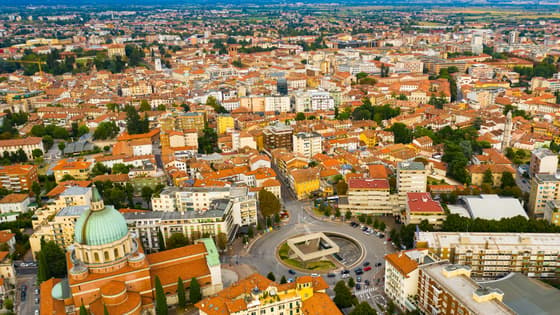
Udine is a city … yet it doesn’t feel like one. Nestled in the heart of region Friuli-Venezia Giulia, in north-eastern Italy, this small yet significant historic place challenges the conventions of the modern world, proving that a human-scale life is entirely possible, even with more than a thousand inhabitants! Overlooking the plains with the Julian Alps standing as a backdrop, Udine (whose ancient name, Oudhène, means “breast-shaped hill”) is an elegant, history-rich “mother.” It nourishes its people with art, tradition, and fine cuisine, but above all, with the quiet serenity that comes from shaping a landscape to suit the human experience. A stroll through the historic old town reveals ancient palaces, evocative squares, monuments, and architectural landmarks that recount centuries of history. At the same time, Udine offers a wealth of cafés, restaurants, shops, and green spaces, ensuring that every moment of your visit is a pleasure.
Udine: past and present
The origins of Udine date back in ages; the first signs of settlement predate Roman rule. Over the centuries, the city grew in importance within the Friuli region, establishing itself as a key political, economic, and cultural center. One of the most significant chapters in its history is the period under the Republic of Venice, which began in 1420 and lasted until the end of the 18th century. This influence remains clearly visible today in the architecture of the historic quarter, with its elegant buildings, porches, and squares that echo the Venetian style. Udine was also home to notable artists, including Giovanni Battista Tiepolo, one of the preeminent figures of 18th-century Venetian painting.
Today, the city has evolved. It has expanded (but not too much) and modernized (again, not too much)! It offers every comfort and diversion without ever feeling alienating, and it has recently discovered that it can rightfully take its place within the tourism circuit. Who says that after visiting Venice, one must necessarily head to Trieste? Udine is a compelling alternative … appealing even to the flow of tourists arriving from Northern Europe or the East (Poland, Russia, China) who have only recently discovered the joy of traveling toward the “south.”
How to reach Udine? What to see in town?
The historic center of Udine is located 33 km from Ronchi dei Legionari, the town that hosts the modern and efficient Trieste Airport. The airport is well-connected to the city via public transport and private taxi services with chauffeurs – an excellent way to travel stress-free while exploring the many attractions that the Friuli region has to offer, both in and around Udine. The center of Udine is easy to explore on foot.
Piazza Libertà is undoubtedly the starting point for all guided tours. Regarded as “one of the most beautiful squares in the Venetian areas”, it stands as a true symbol of the city. Often described as the “living room” of Udine, it serves as a magnificent example of Venetian-style architecture … evident in landmarks such as the Loggia del Lionello, with its stunning white and pink marble façade, or the Clock Tower, which recalls the famous tower in Venice’s Piazza San Marco, or the small Temple San Giovanni .
Another essential stop is Piazza San Giacomo, also known as Piazza Matteotti. It is one of the city’s liveliest and most popular squares, surrounded by historic buildings, cafés, and restaurants. The square is home to the Church of San Giacomo (St James) and boasts a particularly welcoming atmosphere. During the day, it serves as a meeting point for both residents and tourists, while in the evening, it transforms into one of the hubs of Udine’s nightlife.
The Cathedral of Udine, dedicated to Our Lady of the Annunciation, is one of the most significant religious buildings in the Friuli-Venezia Giulia region. Its construction began in the 13th century, and over time, the structure underwent various architectural and decorative modifications. The interior houses highly valuable works of art, including notable examples of Baroque-era painting. The frescoes and decorations are particularly striking, making the cathedral an essential stop for enthusiasts of art and religious architecture.
Also well worth a visit is the Castle of Udine , situated atop a hill overlooking the city center. Accessible via a pleasant – though slightly uphill – walk, the castle offers not only a panoramic view but also the magnificent historical and artistic treasures of the Udine Civic Museums, which encompass collections spanning art, archaeology, photography, and history. If you enjoy museums, be sure to visit Casa Cavazzini as well; within a stunning 16th-century palace, it serves as the home of the Museum of Modern and Contemporary Art.
A city of art and pleasures
Udine is a city deeply intertwined with the history of Italian art. Among its most significant figures is Giambattista (Giovanni Battista) Tiepolo, who left a remarkable legacy in places such as the Patriarchal Palace – home to the “Tiepolo Galleries,” which house a wealth of frescoes and other works by this renowned artist. The Diocesan Museum also preserves pieces linked to Tiepolo and the Venetian artistic tradition, a heritage of which Udine is rightfully proud.
But, we must say it … fine food is an “art” in itself, and Udine certainly knows how to “cook up” beauty! The local gastronomy is defined by authentic flavors, wholesome ingredients, and recipes passed down through generations. Among the best-known dishes is Frico – a beloved Friulian specialty made from local cheese and potatoes. Also worth trying are Cjarsons, a type of stuffed pasta from the Carnia region, prized for their unique balance of sweet and savory notes. Another culinary highlight is San Daniele ham, produced in the town of the same name just a few kilometers from Udine. It pairs perfectly with excellent local wines … such as Friulano, Ribolla Gialla, or Refosco … or even a traditional “Spritz drink”, best enjoyed at one of the many pubs in the city center that feature live music.
What to visit around Udine
Udine’s geographical location makes it an ideal base for excursions into the surrounding area, where you can discover historic villages, natural landscapes, and charming locales.
One of the most compelling destinations is Cividale del Friuli, a UNESCO World Heritage site celebrated for its ancient Lombard treasures, including the famous Lombard Temple (Tempietto Longobardo). Also worth a visit is Palmanova, a fortress city with a distinctive star-shaped layout, recognized by UNESCO as part of the site encompassing Venetian defensive works from the 16th and 17th centuries. A few kilometers away lies San Daniele del Friuli, world-renowned for its PDO-certified “prosciutto” (ham) and its charming historic center. Another must-see is Villa Manin in Passariano di Codroipo – one of the most significant Venetian villas in the Friuli-Venezia Giulia region – which is surrounded by an expansive park.
In less than a 50-minute drive from Udine, you can head up toward the mountains to admire the scenic beauty of the Carnia region and its local villages, perched amidst sheer rock faces and ancient forests, often wreathed in mist and the inviting aroma of polenta.
