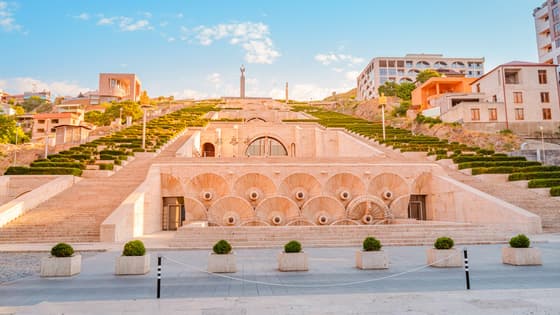
From Yerevan, you can see the volcanoes. The panorama of this city, Armenia’s largest and its capital too, includes the two perpetually snow-capped peaks of the Ararats (Great Ararat and Little Ararat), two ancient, dormant volcanoes that create a captivating backdrop. The peaks are also famous for being mentioned in the Bible: it seems that Noah’s Ark landed here at the end of the flood! And from Yerevan, this historical and natural spectacle is always visible. But beyond the mountains, the Armenian capital offers other splendid sights: the grandiose “stone waterfall”, the spire of the Genocide Museum, the giant (22-meter) statue of Mother Armenia, the TV Tower, the temples… Explore it in May! You will love it!
Erevan or Yerevan?
You will often find the name of the Armenian capital spelled differently. Erevan is the most widespread version, but the transcription of the Russian pronunciation—that is, “Yerevan”—is also accepted on maps. It has existed as a populated center since the fourth millennium BC, but its history is turbulent and has known only two periods of prosperity and stability: Iranian age (16th-18th centuries) and Soviet age (19th-20th centuries). The genocide and deportations inflicted on the Armenians over the centuries have periodically caused the capital to fall into decay. Today, however, it has found a fortunate niche and appears to be increasingly popular as a tourist destination.
To reach Yerevan, land at Yerevan Zvartnots International Airport (EVN), which is only 12 km from the city center and is well served by public and private transport. For itineraries, rely on agencies that offer chauffeur and guide services, as Armenian roads are difficult and sometimes it takes hours to cover just a few kilometers.
Yerevan and history
Before beginning any itinerary in Yerevan, learn about Armenia’s sad history. It is essential to understanding the works and sites you’ll admire later. Start from Republic Square and the History Museum to learn about the nation and the city’s age-old history. Then move on to the Genocide Museum, which is connected to a grandiose monument with a spire and an ever-burning flame at its center.
When visiting Victory Park, you can’t help but pause at the foot of the sword-wielding giantess who seems to bravely defy all fate: the statue of Mother Armenia!
Also include in your tour the 17th-century Red Bridge and Aznavour Square, dedicated to the famous French-Armenian singer. The square is decorated with a majestic “Zodiac” fountain and is surrounded by bars, restaurants, and shops that also offer a lively nightlife.
Religion and nature
The heart of Armenian Christianity is the Cathedral of St. Sargis. The church is majestic and features a façade animated by geometric shapes, while the interior is austere and bare but equally grandiose. The Blue Mosque, instead, is more lively, preserving the last minaret (of four) with spectacular mosaics, shaded by a dome that appears almost baroque, so striking is the pomp of its golden decorations.
The city, despite its nearly two million inhabitants, has many open and green spaces. Among these, the most beautiful is undoubtedly Erebun Park, which extends for 17 hectares and also includes an artificial lake. The English Park and the Lovers’ Park complete the scene, along with Victory Park. The nearby Khosrov and Gegam Mountains reserves can also be considered part of the “greenery of Yerevan.” It takes an hour and a half by car to reach the shores of the immense lake Sevan, 82 km from the capital.
Despite being the symbol of the city—and visible from every corner—the Ararat volcano is located over 500 km from Yerevan and can be reached in a 10-hour drive.
Cascade
Cascade, or the Great Cascade, is perhaps Yerevan’s most famous monument. Located in the city center, this gigantic staircase rises to the top of a 400-meter hill, forming, together with the structures built later, an open amphitheater overlooking Mount Ararat. Designed in the 1920s by Alexander Tamanyan, it was only built in 1980 by architects Jim Torosyan, Aslan Mkhitaryan, and Sargis Gurzadyan.
Partially destroyed by battles following the collapse of the USSR and by several earthquakes, it was completed in 2002, although it still requires some refinement that should finalize the project. The cascade of white stone steps also includes small hanging gardens and several educational and cultural facilities underground, such as the Cafesjian Center for the Arts. There are also restaurants, bars and concert venues. You can reach the top directly via the large external stone stairs or the modern escalators inside.
Why go in May
Why go to Yerevan in May? After all, this is a very “political” month for Armenia, and the festivals held from May 1st to 28th are all related to independence, the republic, and the parliament. However, the festive atmosphere these festivals bring to the city often blends with unmissable cultural and artistic events. And then, in May, Armenia fills with colors, scents, and flavours of a summer-like spring climate that also encourages food tastings.