
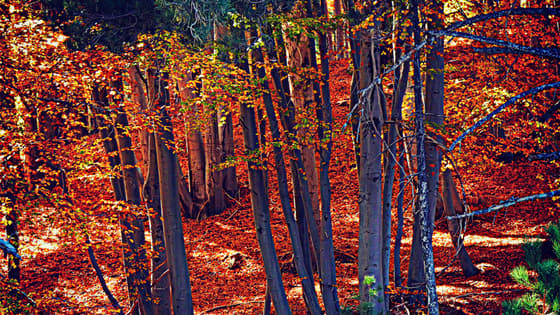
Cyprus is an island located in the eastern Mediterranean Sea, near the coasts of Turkey and the Middle East. It is the third-largest island in the Mediterranean and is renowned for its beaches, mild climate, and rich history. Even here—in the most remote corner of Europe, just a stone’s throw from Turkey and the arid Middle East—the mountains offer spectacular displays of autumn color. It is a wonderful place to admire the autumn foliage, specifically in the Troodos Mountains (whose highest peak, 1,953 meters, is named Mount Olympus!). Beyond their wild, stunning natural beauty, these mountains preserve the island’s most authentic traditions.
Welcome to Cyprus – an island with two souls
Cyprus has long been a point of contention between Christians and Muslims, and between Europeans and Asians. For a long time, it was split in two, with hostile populations regarding one another with suspicion. Today, although the division remains, tensions appear to have eased.
The capital is Nicosia (Lefkosìa in Greek, Lefkosa in Turkish); it is divided by a «Green Line» running through the heart of the historic center, marking the border between the Republic of Cyprus and the Turkish Republic of Northern Cyprus. Key destinations include, besides the capital, the historic cities of Paphos, Salamis, and Famagusta, as well as the monasteries and traditional villages nestled in the mountains.
The Cypriot economy relies primarily on tourism, services, trade, and agriculture. Tourism is further supported by two busy airports—both located in the south, within the Greek Republic—at Larnaca (LCA) and Paphos (PFO). Come and admire and fall in love with this island—not just during the beach season, but especially now, in autumn, when the colors make everything magical.
The Troodos Mountains
The Troodos Mountains are the main mountain range on the island of Cyprus, covering a large part of the country’s southwestern region. The landscape here differs greatly from that of the Cypriot coast: you will find dense pine forests, green valleys, streams, and small traditional villages. The highest peak is Mount Olympus, which also serves as one of the island’s primary ski destinations during the winter.
The mountains are home to a rich variety of wildlife and numerous plant species, some of which are unique to the island. The Cypriot black pine forests are particularly important for the environment and play a key role in biodiversity conservation. In spring and summer, hiking trails offer the chance to explore woodlands, waterfalls, and scenic views of the surrounding valleys.
The region is also of great historical and cultural interest. In the mountain villages, you can see traditional stone houses and churches adorned with frescoes and icons. Ten churches and monasteries in the Troodos region have been designated UNESCO World Heritage sites due to their artistic and historical significance. Among the most renowned are the Kykkos Monastery —one of Cyprus’s most important monasteries, famous for its beautiful gold mosaics—and Trooditissa, a monastery dedicated to the Virgin Mary that is cherished by those seeking peace and meditation. Additionally, the Monastery of Saint John Lampadistis is a complex of Byzantine buildings located just outside the village of Kalopanagiotis. Other ancient villages worth visiting include Omodos, famous for its charming narrow streets and local traditions; Kakopetria, which preserves well-maintained medieval buildings; Pedoulas—the village of cherry trees; and Fikardou—the museum village!
Where and when can you admire the autumn foliage in Cyprus?
The autumn foliage in Cyprus is a natural spectacle that takes as main character the Troodos Mountains, located in the Greek part of the island. The leaves change color relatively late here—towards the middle of November—but the resulting display is truly unique.
Although Cyprus is best known for its sea, beaches, and Mediterranean climate, its mountainous regions reveal a completely different side during autumn. Forests, valleys, and slopes shift through a palette of greens, yellows, oranges, reds, and browns. This foliage phenomenon becomes particularly striking as temperatures drop and daylight hours decrease, turning certain inland locations into photogenic treasures.
Some of the best spots to view the foliage include the areas surrounding the mountain villages of Platres, Kakopetria, and Pedoulas, as well as the numerous hiking trails crisscrossing the Troodos forests.
The autumn foliage also offers a significant opportunity for nature tourism. Autumn invites visitors to explore Cyprus beyond the beach season, offering a quieter, more enchanting atmosphere that reveals the island’s true heart and the authentic character of its people.
A more subdued «foliage» in Turkish Cyprus
Paradoxically, the northern region of Cyprus—occupied by the Turkish Republic—lacks significant elevation, resulting in a milder autumn climate. Consequently, the area does not feature the vast forests you find in the south. However, the time eventually comes here too when pockets of vegetation take on every warm hue of the palette.
To admire the autumn foliage in Turkish Cyprus, head to the Kyrenia Pentadaktylos Mountains. Here, amidst evergreens and olive trees, the limited autumn colors burst forth in November in the undergrowth or in the rare spots where carob, fig, and pomegranate trees nestle. The best way to enjoy the autumn colors along the trails of the Kyrenia Mountains is to explore the local villages, castles (such as Buffavento, Kantara, and Saint Hilarion), and private gardens. Beyond ancient brick walls, you will surely catch sight of red and golden foliage shading your path.
Autumn foliage in Cypriot cities
Wherever you choose to base yourself in Cyprus, city parks also offer small pockets of autumn color. Between photo stops, you can explore fascinating cities that reflect the unique character of an island with two souls.
Nicosia is the island’s capital and largest city. Located in central Cyprus, it is a major political, economic, and cultural hub, renowned for its historic center and ancient Venetian walls. Nearby Athalassa National Park displays beautiful autumn colors. Limassol, situated on the southern coast, is one of Cyprus’s main port cities. It is famous for its beaches, seafront promenade, restaurants, and vibrant cultural scene. The city also hosts major events and festivals. The Municipal Park is a great place to relax amidst the autumn leaves.
Also worth seeing are the cities of Larnaca—on the southeastern coast, known primarily for its international airport, seafront promenade, and lagoon—and Paphos, on the west coast, a city of great archaeological importance; in Northern Cyprus, Gazimağusa (Famagusta) is well worth a visit, boasting beautiful Venetian walls and medieval palaces, as are the protected parks of Karpaz and Ayia Napa (Cape Greco).
