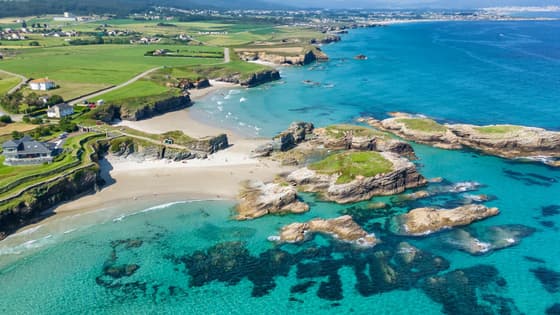
Il existe une région d’Espagne qui semble « moins espagnole » : la Galice, vaste terre verdoyante à l’extrême ouest du pays, dominant la côte nord et seule à baigner l’océan Atlantique. Littéralement « assise » entre le Portugal et la mer, la Galice ne partage que peu de points communs avec l’Espagne. En réalité, c’est une véritable « planète » à part entière. La découvrir, surtout en été, sera une merveilleuse aventure. La Galice est desservie par plusieurs aéroports, dont les plus importants sont La Coruña (LCG) et Saint-Jacques-de-Compostelle (SCQ), tous deux bien reliés au reste du pays par les transports publics et par un service de transport privé très efficace, incluant des chauffeurs privés comme ceux que nous proposons chez Transfeero.
Un balcon surplombant l’océan
La Galice, ancienne colonie romaine peuplée par une minorité gauloise, doit son nom au latin « Gallaecia » (petite Gaule). Son littoral atlantique, escarpé et battu par les vagues depuis des millénaires, abrite aujourd’hui le phénomène des rias, des lieux spectaculaires à visiter et à photographier, véritables caractéristiques de la région. Elles ressemblent à des fjords, mais sont bien plus que de simples fjords. Autre particularité de la Galice : ses promontoires et ses îles, regroupés au sein d’un parc national qui vise à préserver leur caractère unique. Depuis ce balcon maritime, nous entreprenons un voyage vers l’intérieur des terres, où, parmi les nombreuses destinations touristiques, le Sanctuaire de Saint-Jacques, point d’arrivée du célèbre Chemin de Compostelle, se distingue incontestablement.
Les Rías de Galice
Les rias sont de profondes dépressions creusées par l’action de la mer qui, en s’engouffrant dans d’anciennes vallées fluviales, érode progressivement le sol et l’abaisse de fait en dessous du niveau de la mer. Elles se divisent en Rías Altas et Rías Baixas, selon qu’elles se situent au nord ou au sud de la pointe ouest de Finisterre.
Les Rías Altas occupent la côte nord, couvrant une grande partie de la province de La Coruña et abritant des trésors tels que la Tour d’Hercule (le plus ancien phare en activité au monde), le sanctuaire de San Andrés, le parc des Loisirs (le premier parc d’attractions au monde) et la réserve naturelle de Fragas do Eume. Les Rías du sud, dites « basses », s’étendent jusqu’à la province de Pontevedra, incluant la Ría Pontevedra et son parc national des Îles. Ce sont les rias les plus touristiques, donnant sur certaines des plus belles plages de Galice.
Santiago de Compostela
Capitale de la Galice, Saint-Jacques-de-Compostelle est aussi l’une des villes les plus célèbres au monde, point d’arrivée du Chemin de Saint-Jacques. Elle abrite le Sanctuaire Saint-Jacques-le-Majeur, où repose le corps de l’apôtre. Ce qui était à l’origine un pèlerinage catholique est devenu une expérience de vie et de tourisme intense.
Des centaines de raisons poussent des personnes du monde entier à entreprendre ce voyage ardu (plusieurs itinéraires très longs) à pied : la foi, l’espoir, le défi sportif et le désir de vivre une expérience inédite. L’étape finale est le magnifique Sanctuaire Saint-Jacques, construit au 13ème siècle et agrandi à l’époque baroque, qui se distingue aujourd’hui par ses deux hauts clochers et ses trois façades différentes. À l’intérieur, le « Botafumeiro », un imposant brûle-encens de 1,5 mètre de haut, mérite assurément le détour !
Saint-Jacques-de-Compostelle est une ville culturelle, et ses deux musées les plus importants sont le Musée des Pèlerins, qui rassemble récits et objets des nombreux pèlerins ayant parcouru le Chemin, et le Musée du Peuple Galicien, où les visiteurs peuvent découvrir la région sous toutes ses facettes. Pour se détendre, flânez sur les allées ombragées du parc Belvís, le plus grand et le plus beau de la ville.
Le Chemin de Compostelle
Le Camino de Santiago (Chemin de Compostelle) est l’un des itinéraires de pèlerinage les plus célèbres au monde.
Il existe plusieurs itinéraires, mais le plus connu est la Voie Française, qui traverse le nord de l’Espagne sur environ 800 kilomètres. En chemin, les pèlerins traversent des paysages variés : montagnes, campagne, villages historiques et grandes villes. Chaque étape offre l’occasion de rencontrer de nouvelles personnes et de découvrir les cultures et traditions locales.
Un symbole caractéristique du Chemin est la coquille Saint-Jacques, utilisée pour indiquer la direction à suivre. Au terme du pèlerinage, les fidèles reçoivent la Compostela, un document attestant de leur réussite. Le Chemin de Saint-Jacques-de-Compostelle n’est donc pas seulement une destination géographique, mais aussi un important voyage intérieur. Marcher pendant des jours ou des semaines permet de s’évader du quotidien, de redécouvrir un rythme de vie plus lent et d’apprécier la simplicité des choses essentielles.
Autres étapes d’un itinéraire en Galice
Au-delà des Rías et de sa ville la plus célèbre, la Galice offre encore bien d’autres attraits susceptibles de fasciner le touriste de passage. À tel point qu’il pourrait décider de revenir… ou de prolonger son séjour.
À quelques kilomètres de Saint-Jacques-de-Compostelle se dresse le Pazo de Oca, un véritable palais de style galicien typique datant du 15ème siècle. On le surnomme ici le « Versailles espagnol », notamment grâce à son magnifique parc environnant, riche en végétation, ruisseaux, étangs et statues. Lugo, une autre capitale galicienne qui mérite d’être découverte, est une ville romaine aux espaces aérés, dominée par des édifices médiévaux (tours, remparts, palais), parmi lesquels la cathédrale et le Vieux Pont se distinguent. Sur la côte de Lugo, admirez les Catadràis, d’énormes pitons rocheux (30 mètres de haut) sculptés à jamais par la mer en forme de navires gigantesques ! Vous pouvez également vous rendre dans la région de Vigo pour flâner sur la plage de Samil ou sur les sentiers du parc de Castrelos, ou encore découvrir O Castro, une forteresse du 17ème siècle abritant les vestiges d’un ancien village celte.
Les paysages naturels de la Galice sont aussi des monuments fascinants. Montez au Balcón de Madrid, un point de vue dominant les gorges du Síl… le long duquel naviguaient autrefois les bateaux transportant les migrants vers la capitale espagnole. De ce point de vue, les familles les regardaient pour leur dire adieu une dernière fois. Pour admirer la cascade d’Ezaro, retournez dans la région de La Coruña et installez-vous du haut d’une falaise pour contempler cette cascade unique qui se jette directement dans l’océan. Au large de Pontevedra, vous pouvez partir à la découverte des îles Ons, dont la plus grande mesure 5 kilomètres de long et abrite des goélands argentés, des oiseaux migrateurs, des pêcheurs et même des plages paradisiaques très prisées des nudistes !