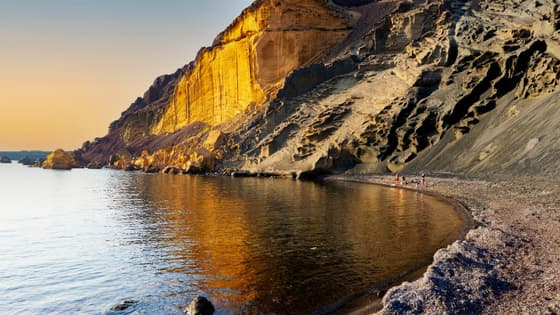
Linosa is the island of turtles and wild nature. And perhaps it’s best for it to stay that way. So why promote it for tourism? Because tourism needs to get used to respecting the nature it immerses itself in, and in order to learn this, it should start visiting places like this island, following very specific rules. Starting to look at nature with eyes of admiration and not with a desire to exploit it will be increasingly crucial for the tourism industry of the future. Linosa – and other small, pristine islands like it – are an excellent testing ground.
How do you get there?
Linosa can be reached by landing directly at Lampedusa Airport (LMP) or by connecting domestic flights after landing at Palermo (PMO) or Catania (CTA) airports in Sicily. From Lampedusa, you can then take the ferry to Linosa. If you have time and desire to relax, you can also embark directly from Agrigento’s port (Porto Empedocle), which is about two-hour drive from both Palermo and Catania.
Linosa and its volcanoes
To tell you the truth… the volcanoes on Linosa are no longer there. They are virtually extinct, but their vents are still clearly visible and spectacular, with their vivid colors and steep sides. In the Pleistocene, a single axis of volcanic eruptions created the Lampedusa archipelago and the island of Pantelleria, and traces of lava activity from that period remain through well-defined fossils.
The volcanic craters are still the most important and beautiful monuments on Linosa. Fossa del Cappellano crater is located in the center of the island and is today a large, densely cultivated basin of 600 meters in diameter. The surrounding vents of Vulcano (195 m in diameter), Monte Rosso (186 m), and above all Monte Nero (107 m) open out. Contrary to its name meaning “black mountain”, Monte Nero’s layers of multicolored rock jut out into the sea, creating a spectacular view. There is also a smaller crater called “Craterino,” 50 m in diameter, located on the slopes of Monte Nero.
Submerged secrets…
Linosa’s most mysterious monuments lie beneath the blue of its crystal-clear sea. These are thousands of archaeological finds left over from the many shipwrecks that occurred on these coasts over the centuries, from Roman times to World War 2.
Among the most significant finds are vases, stone and metal anchors, ceramics, and objects from various historical periods. These artifacts tell the story of the passage of merchants and sailors who crossed the Strait of Sicily. The study and protection of this underwater heritage allows us to reconstruct the history of the island and its past maritime routes. Diving enthusiasts love exploring these seabeds, although most of the artifacts can only be approached by expert archaeologists.
Tourist itineraries on the island
Despite its small size, Linosa offers numerous attractions that captivate visitors with their authenticity. Tourists are asked to experience these itineraries with discretion and respect for the island’s simple life and nature.
One of the most charming places is the port, with its characteristic colorful houses overlooking the waterfront, nestled in a small and intimate village core: small shops, bars, and restaurants are all on a human scale. Respect the locals’ pace, including delays, and don’t complain too much! If you want to admire Linosa from above, climb to the Monte Vulcano lookout point. You’ll enjoy a spectacular view of vineyards, craters, and the blue horizon of the Mediterranean sea.
Swimming is permitted here, provided you adapt to the rocky coves and respect the barriers that mark the nests of Caretta Caretta sea turtles in the sandy areas (such as the black beach of Pozzolana di Ponente). An ideal spot for tourists is the Natural Pool, one of the island’s most beautiful bays. Here, the water is incredibly clear, taking on shades ranging from turquoise to deep blue. It is the ideal place for swimming, relaxing in the sun, or diving to admire the underwater artifacts, as well as the many caves and volcanic cliffs that extend beneath the water.
Along your itinerary, tastings are a must. In Linosa, as in Lampedusa, recipes are based on fresh fish, capers, lentils grown on the island, and extra virgin olive oil. The fish couscous is a must-try… accompanied by excellent local white wines.
Linosa and… the others
Linosa is an integral part of the small Lampedusa three-island archipelago, also known as the Pelagies. Of the three, Lampedusa is the largest and most populous, while tiny Lampione is uninhabited. The archipelago is famous in Europe for its sad record of migrant landings from Africa, which makes news headlines every day.
Despite this, it remains a favorite destination for many tourists. Lampedusa, naturally, attracts the most visitors. Not only is it the largest island, but it also has the best-stocked shops and services. Travelers flock to it for its exotic beaches: Cala dei Conigli is the most famous—overlooking the famous islet of the same name—but equally fascinating are Cala Croce, Cala Francese, Cala Pulcino, Cala Galera, Guitgia, and Porto ‘Ntoni. Among the island’s monuments, one stands out: the one created by artist Domenico Palladino in memory of the many migrants lost at sea: “Gateway to Europe,” inaugurated on June 28, 2008, at Punta Cavallo Bianco. It is a ceramic and iron sculpture, five meters high and three meters wide, whose white color reflects the rays of both the sun and the moon. Nature lovers can also visit the Caretta Caretta turtle rescue center, where these little creatures are cared for in case of injury or disorientation.
Lampione island is the smallest and holds great natural value, as it is part of the Marine Protected Area of the Pelagie Islands . The waters surrounding it are clear and rich in marine life, including groupers, barracudas, sea turtles, and numerous fish species. The island is also one of the few places in the Mediterranean where it’s possible to spot the rare monk seal, a protected species that is very difficult to observe. However, Lampione cannot be visited without a specific permit and a local guide, precisely to preserve its delicate ecosystem and the preservation of unique and precious habitats. Take information at your hotel or at the tour operator that will organize your excursions.